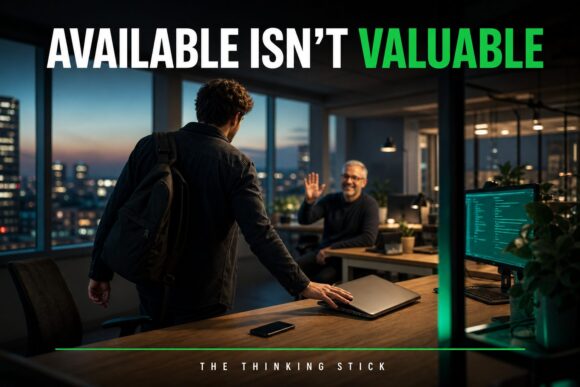
I read two pieces this past week that named something I think most of us have felt for years but never had a word for: performative availability. It’s the habit of proving you care about your work by being reachable, not by what the work actually is. The 9 p.m. email reply. The vacation check-in. The Sunday “quick question.”
And here’s the thing: according to a new survey covered by Fortune, it mostly doesn’t pay off. Only 8% of workers said being available after hours won them a promotion.
So why do so many workplaces still run on it? And why is it Gen Z, the generation we keep being told lacks commitment, that is the first to question the deal?
Key takeaways
- Performative availability means showing commitment through visibility and responsiveness instead of the value of your work.
- In a Software Finder survey of 1,006 U.S. workers, 69% said after-hours availability had not meaningfully improved their careers, and only 8% linked it to a promotion.
- Gen Z reported less pressure to respond after hours (65%) than Millennials and Gen X (72%), which says more about workplace norms than about anyone’s work ethic.
- Fixing it is a leadership job: separate real performance needs from performative expectations, and make real contribution visible.
What the new research on performative availability says
On November 2, Jeff LeBlanc, a lecturer at Bentley University, wrote a column for Fast Company titled “Gen Z is challenging ‘performative availability.’ Why aren’t Millennials and Gen X doing the same?” He defines performative availability as the compulsion to demonstrate commitment through visibility rather than through the value of your work, and he puts it plainly: “If you respond to a message at 9 p.m., you’re a dedicated employee.” That’s the unwritten rule he says too many workplaces still follow.
His column draws on a survey of 1,006 American workers from Software Finder, a software comparison platform. In that survey, 71% of respondents said they felt pressured to be available outside of working hours. The pressure was higher for Millennials and Gen X (72%) than for Gen Z (65%).
Then on November 8, Fortune’s Cordell Jones reported more of the same survey’s findings. 69% said after-hours availability has not meaningfully improved their careers. Only 8% credit it with a promotion and 12% with a raise or bonus. Meanwhile, 40% said it worsened their work-life balance, 38% said it raised their stress, and 32% said it worsened burnout. Workers the survey describes as “always on” were 2.8 times as likely as boundary-setters to report worsened burnout.
To be fair to the other side of this, the always-on group was much more likely to say availability helped them: 57% said so, compared with 8% of boundary-setters, and 17% of always-on workers credited availability with a promotion. And 49% of all workers said they worry that setting boundaries could hurt their careers. That worry isn’t irrational. Fortune also pointed to a 2025 study in which managers rated employees who unplugged after hours as more productive, but less committed and less deserving of promotion, even when their performance reviews were identical.
A quick honest note on the data: this is one survey from a software company, and the coverage doesn’t give much detail on methodology. I wouldn’t build a policy on any single number in it. But the pattern lines up with something much larger. Fortune notes that Deloitte’s 2026 Gen Z and Millennial Survey, with more than 22,500 respondents in 44 countries, found 48% of Gen Zs and 45% of Millennials saying they feel burned out.
Gen Z isn’t lacking commitment. They’re questioning the proof.
I hear some version of this in almost every session I run with leaders: “Young people just don’t want to put in the time.” I understand where that comes from. Many of us built careers in workplaces where being seen was part of the job. Answering fast was how you showed you were serious.
But look at what the data actually says. The group feeling the least pressure to perform availability is Gen Z, and the people LeBlanc says may be reinforcing the expectation, often without meaning to, are the Millennials and Gen X leaders now running teams. His conclusion is one I agree with: “It’s a managerial issue.”
That’s not a knock on Millennials or Gen X. It’s a knock on a system that taught all of us to use responsiveness as a stand-in for quality, because quality is harder to see.
In The Next Turn, I argue that this is exactly what’s breaking right now. When AI can produce a draft, a summary or a slide deck in seconds, effort and activity stop being reliable signals of value. Being online at 9 p.m. tells you even less. What leaders actually need to see is judgment: what someone decided, why, and what happened because of it. “The standards remain. The proof system changes.” Performative availability is an old proof system, and a lot of people are still paying for it in burnout.
And yes…. this is also why I keep saying “Gen Z is not the problem. Gen Z is the clearest signal.” When the youngest people in your organization push back on a norm, they are often just the first ones to say out loud that the value exchange doesn’t add up.
This starts long before the first job
I can’t write about this without thinking about schools. For years I’ve argued that we need to teach students when to connect and when to disconnect, and to talk with them about why. I wrote about it back in 2016 in The power of disconnecting. Disconnecting isn’t anti-technology. It’s a skill, and it’s one adults in workplaces are clearly still learning.
Here’s my question for schools: are we teaching students that the quality of their work is what matters, or that being responsive is? When a teacher replies to a student at 11 p.m., or a learning platform pings a kid on a Saturday night, what habit are we modeling? Our students are watching how the adults around them handle being always reachable.
Preparing students for their future, not our past, means helping them build healthy boundaries with technology and the confidence to show the value of their work, so they don’t walk into their first job believing a fast reply is the same as a good one.
What leaders can do this week
- Name the real after-hours needs. LeBlanc’s advice is to separate actual performance needs from performative expectations. Write down which situations truly require a response outside working hours. Everything else can wait until morning.
- Set and say team communication norms. Put them in writing. If you send messages late because that’s when you think, tell your team you don’t expect a reply until the next workday. Better yet, schedule the send.
- Audit what you praise. Look at the last few times you publicly thanked someone. Was it for the quality of a decision or a contribution, or for being quick and available?
- Make contribution visible. Give early-career employees clear ways to show their thinking: short project debriefs, decision logs, portfolios of work. If you want them to stop performing availability, give them a better way to be seen.
- Check your promotion conversations. If “always there when we need them” is showing up as a reason for promotion, ask what results sit behind it.
Frequently asked questions
What is performative availability?
Performative availability is the pressure to show you care about your job by being visible and reachable, such as answering messages late at night or on vacation, rather than through the value of the work itself. Bentley University lecturer Jeff LeBlanc used the term in a November 2026 Fast Company column.
Does answering work messages after hours help your career?
For most workers in a recent Software Finder survey of 1,006 U.S. employees, no: 69% said it hadn’t meaningfully improved their careers and only 8% linked it to a promotion. Workers who were “always on” were more likely to say it helped, but they were also far more likely to report worse burnout.
How should managers handle Gen Z employees who set boundaries?
Treat boundaries as a conversation about expectations, not a sign of low commitment. Be clear about which situations truly need an after-hours response, and evaluate people on the quality of their contributions. Clear expectations help every generation on the team, not only the youngest employees.
The bottom line
Being available isn’t the same as being valuable. It never was, but in a world where AI is changing what work even looks like, the gap between the two is getting harder to ignore. Gen Z just happens to be the first to say it out loud.
If your school or organization is working through how to lead across generations while AI changes how work happens, this is the work I do with leaders every week. You can find me at JeffUtecht.com.
So let me ask you: what does your organization actually reward, the work or the reply time?
Sources
- Gen Z is challenging ‘performative availability.’ Why aren’t Millennials and Gen X doing the same? — Fast Company, Jeff LeBlanc, November 2, 2026
- Gen Z pushes back on ‘performative availability’ as only 8% of workers say it won them a promotion — Fortune, Cordell Jones, November 8, 2026