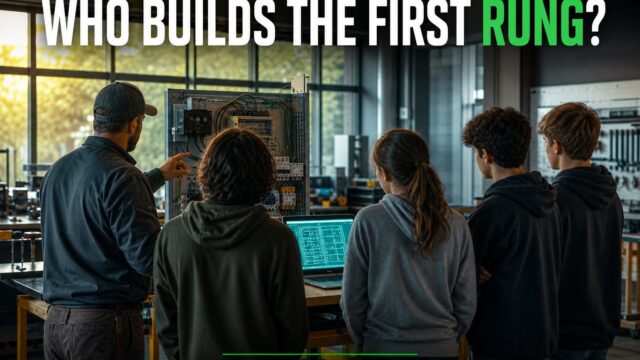
Here’s a question I want every leader who has paused entry-level hiring this year to sit with: who are you going to promote in 2036? I read a piece in HR Dive this week that framed early-career development as a ten-year problem, not a this-quarter problem, and I haven’t been able to shake it. If AI is doing the starter work and nobody is doing the starter learning, the gap doesn’t show up today. It shows up a decade from now, right in the middle of your org chart.
Two other pieces this week filled in the rest of the picture. One says AI coaching tools alone don’t develop leaders very well. The other says that if the first job is disappearing, we’d better build other ways in. Put them together and you get a clear message for employers: the first rung of the ladder was never just a job. It was where people learned how to work.
Key takeaways
- Cutting entry-level hiring now can leave organizations with no one ready to promote into middle management about ten years from now, a gap Guild economist Guy Berger calls a “donut hole.”
- AI coaching works best alongside a human: in DDI’s Global Leadership Forecast 2027, 64% of leaders who got both AI and manager coaching rated their development high quality, versus 39% with AI coaching alone.
- Only 1 in 4 leaders in that same research said their own manager was an effective coach, so the human side of early-career development needs the most investment.
- If AI absorbs starter tasks, employers have to design the learning those tasks used to provide: cohorts, clear career paths, coaching and new on-ramps into work.
What’s happening: the missing rung
On November 10, Kathryn Moody at HR Dive published a piece on what she calls the “missing rung”. It builds on an analysis by Guy Berger, the workforce economist in residence at Guild. The argument is simple. Employers are pulling back on entry-level hiring, partly because AI can now handle a lot of that work. That might look efficient this year. But as Berger puts it, “Do that for a few years and you won’t have anyone to promote into the middle a decade from now.”
And the obvious workaround, just hire experienced people away from competitors later, has a flaw. Berger again: “It’s tempting to think you can fix a donut hole later by poaching. But almost everybody in your industry is doing the same thing.”
The article’s advice to employers is practical: build a purposeful pathway of learning to replace the skill building that entry-level work used to provide, build clear career paths, and “lean into new hire cohorts to emphasize learning and bonding.” It also flags a real constraint. Managers are already dealing with burnout, so simply piling new-hire development onto them isn’t a plan.
The same day, HR Dive’s Lara Ewen covered new findings from DDI’s Global Leadership Forecast 2027. Almost three-quarters (72%) of HR professionals have used or plan to use AI-based learning tools for leadership development, but only 37% of companies using those tools have seen strong results. The difference came down to people. Of leaders who received both AI and manager coaching, 64% called their development high quality. That dropped to 45% for manager coaching only and 39% for AI coaching only. And here’s the uncomfortable number: only 1 in 4 leaders believed their manager was an effective coach. The article makes the connection to young workers directly: “As AI takes on tasks previously given to early career workers,” it may also be affecting the development of critical skill sets.
Then, in The 74, City Year CEO Jim Balfanz wrote an opinion piece arguing that national service can be a bridge from school to work. His line that stuck with me: “It’s not only about the entry-level jobs that will disappear; it’s about what students trying to begin a career will lose.” City Year places AmeriCorps members ages 17 to 25 in schools as student success coaches, where they learn to lead teams and solve real problems. To be fair to the reader, Balfanz runs the organization he’s writing about, so read it as an argument, not a neutral study. But his point about what gets lost holds up whether or not you buy national service as the answer.
The first job was never just about the work
Here’s the thing. When I think back on most people’s first real jobs, the tasks themselves weren’t the point. The point was everything around the tasks. Watching how someone handled a frustrated customer. Getting your work sent back with red marks and learning why. Sitting in a meeting with no idea what the acronyms meant and slowly figuring it out. Being trusted with something small, then something bigger.
That’s the part AI doesn’t replace when it takes over the starter tasks. It takes the tasks and quietly removes the apprenticeship that came with them.
I’ll admit I understand why leaders are making these calls. Budgets are tight, AI really can draft the first version of a lot of things, and nobody gets rewarded for hiring people they don’t need yet. I’m not saying every organization has to keep every entry-level role exactly as it was. But if you remove the rung, you have to replace the learning. Otherwise you’re borrowing against your own future bench.
In The Next Turn, I argue that as AI handles more of the routine work, judgment becomes the thing that matters most, and judgment is built by doing real work with feedback from people who have done it before. You can’t download it. That is exactly what the missing rung threatens.
Early-career development is a human job
The DDI numbers are the part I’d put in front of every executive team. AI coaching on its own produced the weakest results of the three groups. AI plus a human coach produced the best. So the tools aren’t the problem. The tools without people are the problem.
But then look at that 1 in 4 number again. Most leaders don’t think their own manager is an effective coach. So if we’re going to rely on managers to develop young workers, we have to develop the managers first. And give them time to do it, because the burnout warning in the Moody piece is real.
This reminds me of something I wrote back in 2014 in New Teachers Won’t Save Us. The research I cited then noted that the people with the biggest influence on new teachers were the veteran educators around them. The same is true in every workplace. Newcomers learn the job from the people next to them. If those people are stretched thin, untrained as coaches, or replaced by a chatbot, the newcomer learns a lot less.
One more line I keep coming back to from my own work: “Gen Z is not the problem. Gen Z is the clearest signal.” Young workers aren’t the reason the first rung is disappearing. They’re just the first people to feel it. When a young graduate says they don’t know how to get experience without already having experience, that’s not a complaint. That’s a description of a system we built.
And for those of us in K-12, this matters too. If employers are rethinking how people learn to work, schools are part of that bridge. Internships, apprenticeships, service and real projects for real audiences all help young people walk in the door already knowing how to learn on the job. That’s what preparing students for their future, not our past, actually looks like.
What leaders can do this week
- Map your 2036 bench. List the middle-management and lead roles you’ll need filled in ten years. Where do those people come from if you hire fewer early-career employees now?
- Name what the old starter tasks taught. For each entry-level task AI now handles, write down the skill it used to build. Then decide where that learning happens instead.
- Start or restart a new-hire cohort. Even a small group that meets regularly to learn together gives newcomers peers to ask the questions they won’t ask in a big meeting.
- Pair AI tools with a human. If you’re rolling out AI coaching or learning tools, make sure every early-career employee also has a named person who reviews their work and talks it through.
- Coach the coaches. Give managers training and protected time for developing people, and take something else off their plate to make room.
Frequently asked questions
What is the “missing rung” in early-career hiring?
It’s the gap that forms when employers cut entry-level hiring, often because AI can do more of that work. The concern, raised by Guild economist Guy Berger in HR Dive, is that a decade later there’s no one with enough experience to promote into middle management.
Can AI coaching tools replace managers in developing young employees?
The current evidence says no. In DDI’s Global Leadership Forecast 2027, leaders who received AI coaching alone were the least likely to rate their development as high quality (39%). Those who had both AI and manager coaching were the most likely (64%).
How can employers support Gen Z workers when AI does the entry-level tasks?
Replace the learning those tasks used to provide. That means clear career paths, new-hire cohorts, regular human feedback on real work, and managers who are trained and given time to coach. Partnerships with schools and service programs can also help young people build experience before their first job.
The bench you build now
Every organization I know wants strong leaders ten years from now. Very few are designing for it today. The first rung used to do that work for us, mostly by accident. AI is making it something we have to do on purpose.
If your organization is working through how to develop young workers while AI changes the work, this is what I help leaders think through every week. You can find me at JeffUtecht.com.
So I’ll ask again: who are you going to promote in 2036, and what are you doing this year to make sure they’re ready?
Sources
- Lack of hiring now will create a ‘missing rung’ that may topple growth — HR Dive, Kathryn Moody, November 10, 2026
- AI leadership training tools are most effective when paired with managerial support — HR Dive, Lara Ewen, November 10, 2026
- What AI Can’t Teach, National Service Can — The 74, Jim Balfanz (opinion), November 10, 2026