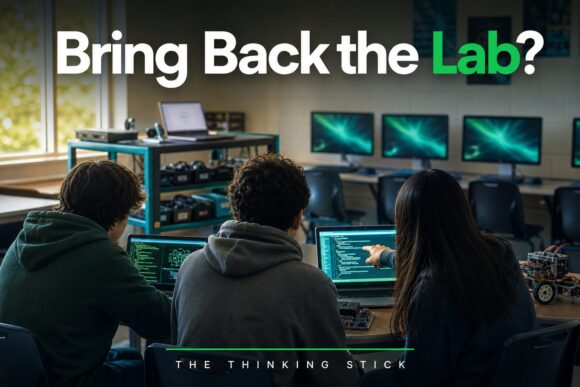
The newest target in the screen debate isn’t the phone in a student’s pocket. It’s the laptop the school handed them. This week Brian Fitzpatrick of the Fordham Institute made the case in The 74 that we should ditch school-issued laptops and bring back computer labs. Read it next to a story out of Memphis, where the district already took student laptops away this fall and is now asking to buy 25,000 of them back, and you get a pretty good picture of where this conversation is headed.
I’ll admit the distraction data is hard to look at. But I’ve been through the computer lab era and the 1:1 era, and here’s the thing.
The laptop was never the point. So taking it away won’t be the fix either.
Key takeaways
- A new Fordham Institute survey finds 76% of high schoolers report some daily off-task tech use in school, and its author now argues for pulling back school-issued laptops.
- The same survey is not a causal study, and its own findings point to firewalls, grading practices and phone policies as part of the problem.
- Memphis ended 1:1 devices before this school year, heard from frustrated parents and teachers, and is now proposing a $22 million purchase of 25,000 laptops.
- Distraction is a design and leadership problem. Removing school-issued laptops moves the problem; it doesn’t teach students to manage it.
What’s happening with school-issued laptops
Fitzpatrick’s piece in The 74 (November 9) builds on a Fordham report released this fall, High Tech, Low Standards: High School in the Age of Distraction. Fordham surveyed more than 2,000 current high school students and recent graduates in February and March of 2026. As K-12 Dive reported on November 11, just over three-quarters of high schoolers said they misuse tech during school hours, about one in five said they use AI without a teacher’s permission, and 62% said they spend more than half of their class time on school-issued devices.
Fitzpatrick’s argument, in its strongest form: phones aren’t the only source of distraction, school devices are “an equal partner in crime,” and AI is going to make that worse. He writes:
One-to-one devices enable distraction and cheating, and these problems will only get worse in the age of AI.
Brian Fitzpatrick, The 74
He wants high schools to sharply curtail or eliminate 1:1 devices and teach computing and AI in labs or with laptop carts. He also argues that the research on laptop access is mostly small-scale and that the better studies are underwhelming. To his credit, he is careful about what his own data can and can’t say: “Our recent research isn’t a causal study and won’t settle this debate.” He says states shouldn’t impose this top-down, that local leaders, boards and parents should decide, and that some students, like those in AP computer science or STEM magnet programs, could still benefit from their own device.
Then there’s Memphis. Chalkbeat’s Bri Hatch reported on November 10 that Memphis-Shelby County Schools quietly ended its COVID-era policy of giving every student a laptop or tablet before classes started in August, in part to be “more intentional” with digital resources. Parents said they were blindsided. Earlier reporting found the change hindered testing and lesson plans at one high school and raised concerns about students who couldn’t bring a device from home. Now district leaders are proposing a mid-year purchase of 25,000 laptops for high schoolers, roughly $22 million, with the goal of having them in place by February 2027, before standardized testing ramps up. The new plan is not 1:1; it’s a take-home checkout model from school carts for students in college or asynchronous courses.
So in the same week, one voice says take the laptops away, and one district that did is spending millions to put many of them back.
Here’s what the laptop headline leaves out
Let’s start with what’s true. Kids are distracted. Teachers see it every day, and I’m not going to pretend otherwise. If 76% of high schoolers report at least some daily off-task use, that’s a real problem worth solving.
But read the Fordham report closely and the laptop isn’t the only thing in the frame. Two-thirds of students said YouTube is accessible on their school device. That isn’t a feature of 1:1. That’s a configuration choice somebody made. The report’s own recommendations include making sure school-device firewalls actually work. It also found that 57% of students report getting all or mostly A’s, and the authors argue that weak grading standards make distraction and AI misuse worse. And on phones, students in schools that lock phones away reported daily social media use at 33%, compared with 64% where the policy was left to individual teachers. That tells me consistency and leadership matter a lot.
So the questions I’d ask before rolling the carts back in:
- Why is YouTube open on two-thirds of school devices, and who decided that?
- What are students being asked to do on those devices? If most of class time is on a laptop, is that time spent creating, researching and collaborating, or clicking through worksheets?
- If an assignment can be finished by AI in thirty seconds, is the problem the laptop or the assignment?
- Were teachers ever trained to manage a class full of screens, or were devices handed out in 2020 and left to run?
I asked a version of that last question back in 2009 in What’s the purpose of going 1:1. The purpose was never “every kid gets a laptop.” It was redesigning learning so students had the tools of their world in their hands. A lot of schools skipped the redesign. In Memphis, 1:1 was a COVID-era policy, and the district says many of its pandemic-era devices are aging out or broken. Devices bought to keep school running during an emergency are not the same thing as a learning plan. How many districts ever went back and built the plan?
This is exactly what I mean when I say “AI didn’t break school — it exposed it.” I make that case at length in Human Still Required: the tools changed, but the work of leading teaching and learning didn’t. AI didn’t create low-rigor tasks or inconsistent grading. It just made them impossible to ignore.
We have a choice. They don’t.
Here’s my bigger worry about the computer lab model. When the computer lives down the hall, technology becomes a place you go instead of a tool you use. I taught through that era. In too many schools, the lab became the place you “did computers” once a week, and the rest of learning stayed the same. I wrote back in 2016 that we have a choice, they don’t. Adults can decide how much technology to let into their lives. Our students can’t opt out of a future of work that runs on it.
Memphis also shows the equity question up close. When school devices disappear, the students with a good laptop at home are fine. The students without one are the ones left out, and their parents and teachers were the ones raising the alarm. Fitzpatrick suggests loaner laptops for students who can’t afford one, which is fair. But will a loaner system really give those students the same daily access their classmates have at home?
And there’s the active vs. inactive point I keep coming back to. Watching unassigned YouTube in math class is inactive screen time. Building a model, editing a podcast, writing code or researching a local issue is active. Removing the device takes away both. Teaching students the difference, and when to put the device down, is the skill. Banning teaches nothing. Teaching does. I’d rather we spend our energy on that than on another round of whack-a-mole.
None of this means every class should be on a laptop all period. Fitzpatrick is right that there’s nothing wrong with a laptop cart in the right setting, and plenty of lessons are better with paper, conversation and no screens at all. Yes…. But that’s a decision teachers should make on purpose, lesson by lesson. Not one we make by taking the tool away from everyone.
Preparing students for their future, not our past, means teaching them to use powerful tools well, not keeping those tools behind a locked door.
What school leaders can do this week
- Audit what’s open on student devices. If YouTube, games or shopping sites are accessible all day, start there. That’s a settings conversation, not a 1:1 conversation.
- Walk five classrooms and note what students are doing on screens. Creating, or consuming? Use that to start a staff conversation, not a policy memo.
- Pick one common assessment and redesign it so AI can’t do it alone. Add an oral defense, an in-class draft, or a real audience.
- Make norms schoolwide. Fordham’s phone data suggests consistency matters. Agree on when lids are down and when screens are up, and teach students why.
- Before changing device policy, ask who gets left out. Check testing schedules, home access and the students who don’t have a device of their own.
Frequently asked questions
Are school-issued laptops bad for learning?
The research is mixed, and the newest Fordham survey shows widespread off-task use but is not a causal study. How devices are used, configured and managed matters more than whether they exist. A laptop used for creating and research is a different thing than one used to stream videos in class.
Should my school go back to computer labs?
Labs and carts can work for some classes, and some lessons don’t need screens at all. But going lab-only makes technology a destination rather than a tool, and it can hit students without home devices hardest. Memphis tried pulling back 1:1 and is now proposing to buy 25,000 laptops.
How can teachers reduce laptop distraction without banning devices?
Start with working filters, clear schoolwide norms for when screens are up and down, and tasks that require students to create or explain their thinking. Teach students why and when to disconnect, not just that they must.
The real question
I don’t think Fitzpatrick and I disagree that students are too distracted. Where we differ is on the fix. Taking school-issued laptops away treats the device as the problem. I think the problem is what we’ve asked students to do with it, what we’ve left switched on, and whether anyone taught them how to manage it.
If your school or district is wrestling with device policy and AI right now, this is the work I do with leaders every week. You can find me at JeffUtecht.com.
So what is your school doing: pulling back devices, or rethinking how they’re used?
Sources
- Ditch School-Issued Laptops and Bring Back Computer Labs — The 74, Brian Fitzpatrick (opinion), November 9, 2026
- Memphis parents complained of a school laptop shortage. Now MSCS wants to buy 25,000 more. — Chalkbeat Tennessee, Bri Hatch, November 10, 2026
- Majority of students report misusing tech during school hours — K-12 Dive, Naaz Modan, November 11, 2026