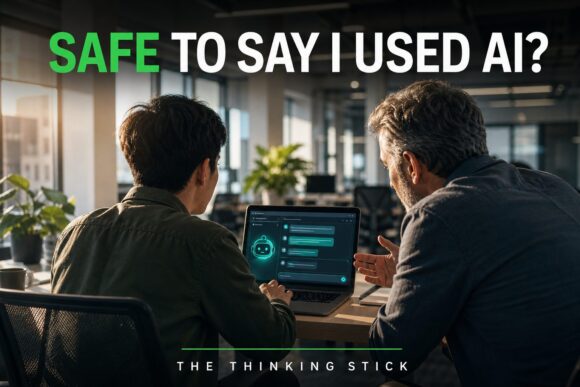
Here’s a number that stopped me this weekend. In a new Seramount survey of U.S. white-collar workers, only 27% of Gen Z employees said they feel comfortable acknowledging that they used AI for a work task. For older colleagues it was 47% to 53%. If you lead people, that gap should bother you, because it says something about Gen Z and AI at work that most of the headlines are getting backwards.
The headline Fortune ran on November 21 was “Only 18% of Gen Z workers want to build AI skills.” I don’t think that’s what the data is telling us. I think it’s telling us young workers are stuck in a double bind we built for them.
Key takeaways
- In Seramount’s survey, Gen Z workers were the least likely of any generation to say they’re comfortable admitting AI use (27%) or asking a colleague for help with AI (18%).
- A separate LSE and Protiviti study found 48% of employees worry about being judged for not using AI enough, while 20% worry about being judged for using it.
- Early-career workers don’t yet have a track record to offset doubts about their AI use, so the “AI penalty” lands hardest on them.
- This is a leadership design problem, not a motivation problem: make AI use visible, safe and taught, and judge people on judgment, not on whether a tool touched the work.
What the new research on Gen Z and AI at work actually says
Three pieces landed within days of each other, and they belong together.
First, Seramount released AI at Work: Employee Experiences Across the Workforce in November. The survey was fielded in June 2026 through NORC’s AmeriSpeak panel and includes more than 1,800 U.S. white-collar employees at companies with at least 500 workers. Seramount defines Gen Z as workers 29 and younger. A few of the Gen Z findings from the executive summary:
- 58% of Gen Z say they currently use AI at work, compared with 67% of Gen X.
- 18% of Gen Z say they want to develop or improve their AI skills, which the report describes as half the share of Millennials.
- 22% of Gen Z worry that using AI makes others think they lack skills, compared with 10% of Millennials and Gen X and 8% of Baby Boomers.
- 18% of Gen Z feel comfortable asking colleagues for help using AI, compared with 34% of Baby Boomers.
- 27% of Gen Z agree their organization supports them in integrating AI into their work, compared with 38% of Millennials and 43% of Gen X.
Second, the Fortune piece by Bilin Lin put that survey next to research from Jessica Reif, now an assistant professor of management at Wharton. Her study in PNAS, done with Richard Larrick and Jack Soll, ran four experiments with more than 4,400 participants and found that employees described as getting help from AI were seen as less competent, less diligent and lazier than people getting other kinds of help. Reif explained to Fortune why that lands harder on young workers:
Because younger workers haven’t had the same amount of time in their career fields to build up their standing as experts, using a technology that blurs their own contribution to their work can feel especially risky.
Jessica Reif, Wharton, in Fortune (Nov. 21, 2026)
Third, on November 17 the Inclusion Initiative at the London School of Economics and Protiviti released their third annual study of AI at work, a global survey of 3,001 professionals. It found 74% now use AI at work, up from 29% in 2024. And here’s the other half of the bind: 48% of employees worry about being judged for not using AI enough, while only 20% worry about being judged for using it.
So read those together. The organization signals that you should be using AI. Your colleagues may quietly think less of you when you do. And if you’re 24 and have been in the job eight months, you have the least room to absorb either judgment.
Of course you keep quiet about it.
Gen Z is not the problem. Gen Z is the clearest signal.
I want to be fair to the other reading of this data, because there is something to it. Seramount itself suggested junior staff may need AI less in their current roles, or may have less access to enterprise AI tools. That’s about what work gets handed to the newest person in the room, not attitude. And Fortune noted that Gallup research released in April found 80% of Americans aged 14 to 29 think AI tools are likely to make learning harder for them in the future. Some of that hesitation may be young people protecting their own learning. That’s not a weakness. That’s judgment.
There’s also a data wrinkle worth naming. The LSE and Protiviti study found 66% of Gen Z employees had received AI training in the past year, compared with 40% of Baby Boomers. That’s a global sample, and Seramount’s is U.S. only, so I wouldn’t stack the numbers on top of each other. But it raises a good question: if many young workers are getting trained, why do so few feel supported or safe using what they learned?
Here’s the thing. Training is not the same as permission. You can send someone through an AI course and still run a culture where using the tool in front of your manager feels like admitting you cheated.
In The Next Turn, I write about this exact tension. For a long time effort was the signal leaders read: long hours, visible struggle, the all-nighter. AI is collapsing effort as a signal, and a lot of organizations haven’t replaced it with anything. So people fall back on the old read: if a tool helped, it must not really be yours. The way I put it in the book: “The standards remain. The proof system changes.” The bar for good work doesn’t drop. What changes is how someone shows they met it.
And this is where the LSE finding I keep coming back to matters most. The researchers found no consistent link between how employees believe leaders see their performance and whether they adopted AI, got trained or had in-house tools. Higher perceived performance was linked instead to conscientiousness, resilience, confidence in solving problems and willingness to learn. In other words, the people seen as strong are the ones showing judgment and growth, not the ones with the most or least AI in their workflow.
That should be the standard. Not “did a machine touch this,” but “can you explain it, defend it and improve it?”
We spent years teaching them to hide it. Let’s stop.
Let’s be real about where some of this may start. For the last few years, a lot of students heard some version of one message about AI in school: if you use it, you’re cheating. Many schools have moved past that, and the best ones are teaching students when to use AI and how to show their thinking. But plenty of young people walked into their first job having learned that AI use is something you keep to yourself. I wrote back in 2019 that whack-a-mole is not a classroom management strategy that works. It doesn’t work in an office either.
Back in 2013, in Millennials and the Job Market, I argued that young people needed to show their work publicly, not just list it on a resume. The same idea applies here. If we want early-career workers to use AI well, we have to make showing the process normal: here’s what I asked, here’s what it gave me, here’s what I changed and why. That’s the proof system. And it’s the same thing good schools are working toward when they talk about preparing students for their future, not our past. The handoff from school to work should continue that, not undo it.
Diana Forster, senior director of research at Seramount, said in the release covered by Fortune: “If Gen Z falls behind on AI, employers risk weakening their future leadership pipeline.” I agree. But I’d frame it differently. Gen Z isn’t falling behind on its own. We’re asking our youngest workers to take the biggest reputational risk with the least support.
What leaders can do this week
- Say it out loud. Tell your team, in plain words, where AI use is expected, where it’s fine and where it isn’t. Seramount found only 38% of all employees say their organization has clear AI policies and procedures. Don’t make people guess.
- Go first. Senior people have the track record to absorb the risk. Share how you used AI on something this week, including what it got wrong. Your newest hire is watching what’s safe.
- Ask for the process, not just the product. Add one line to project check-ins: “What tools did you use, and what did you change?” Make it routine so it stops feeling like a confession.
- Pair people up on purpose. Only 18% of Gen Z in Seramount’s survey felt comfortable asking colleagues for AI help. Assign AI buddies across generations so the asking is built in, and let it run both ways.
- Check who has the tools. If your junior staff don’t have the same access to enterprise AI as everyone else, fix that before you judge their adoption numbers.
Frequently asked questions
Why are Gen Z workers less likely to admit using AI at work?
In Seramount’s November 2026 survey, 22% of Gen Z workers worried that using AI makes others think they lack skills, more than double the rate of Millennials or Gen X. Research by Wharton’s Jessica Reif suggests the worry is grounded: people described as getting AI help are often judged as less competent, and early-career workers have less track record to offset that.
Does Gen Z really not want to learn AI skills?
Only 18% of Gen Z in the Seramount survey said they want to develop their AI skills. But the same survey found lower feelings of organizational support and equal tool access among Gen Z, and Seramount suggested junior roles may need or offer less AI. Low interest may reflect the job and the culture as much as the person.
How should managers evaluate work when employees use AI?
Judge the quality of the thinking, not whether a tool was involved. Ask employees to explain what they asked AI, what they kept and what they changed. The LSE and Protiviti study found perceived performance tracked with traits like conscientiousness and willingness to learn, not with AI adoption itself.
If we want young workers to grow into the leaders we’ll need in ten years, we can’t leave them alone with a tool everyone expects them to use and no one will admit to using. That’s not a technology problem. It’s a trust problem, and trust is a leader’s job.
If your organization is working through how to lead across generations while AI changes the work, this is what I help leaders with every week. You can find me at JeffUtecht.com.
So let me ask you: on your team, would your newest hire feel safe telling you they used AI on their last project? How do you know?
Sources
- Only 18% of Gen Z workers want to build AI skills. A Wharton professor says using AI is riskier for them — Fortune, Bilin Lin, November 21, 2026
- AI at Work: Employee Experiences Across the Workforce — Seramount, November 2026
- AI at work: 48% of employees worry they will be judged for not using AI enough, LSE and Protiviti research finds — Protiviti and The Inclusion Initiative at LSE, November 17, 2026