Last Thursday a team at Karolinska Institutet in Sweden published one of the more careful studies we’ve had on screen time and mental health. They followed more than 21,000 twins from age nine into adulthood. And when they compared twins inside the same family, most of the link between screens and depression and anxiety got a lot weaker.
The same day, NPR Illinois was reporting that Illinois has passed a school cellphone ban this year, and that schools and parents are now looking hard at the laptops, too.
Here’s the thing. Our policies are getting simpler at the exact moment the research is getting more complicated. We’re counting minutes. The researchers are telling us minutes aren’t the whole story.
Key takeaways
- A Karolinska Institutet study of 21,797 Swedish twins, published October 8, 2026 in Nature Human Behaviour, found that shared family factors explain much of the link between screen time and mental health problems in young people.
- The clearest links were with interactive use like gaming, chatting and browsing; watching TV or videos showed weaker or no links.
- The link did not disappear entirely, and heavy use at 15 still deserves attention, but the authors found limited evidence of a clear causal effect.
- Schools and families should ask what students are doing on screens and what is going on around them, not just how many minutes they log.
What the twin study found about screen time and mental health
The study is titled “Recreational screen use and internalizing problems from preadolescence to young adulthood in a longitudinal twin cohort with co-twin comparison.” It was published online in Nature Human Behaviour on October 8, 2026, led by Tong Gong and Yi Lu of Karolinska Institutet with a team of co-authors.
The researchers used the Child and Adolescent Twin Study in Sweden. They had screen-use and symptom data at ages 9, 15, 18 and 24, and they linked it to Swedish national health records to see who was later diagnosed with depression or anxiety or prescribed an antidepressant.
Why twins? Because twins share a home, a family and, in the case of identical twins, their genes. If one twin used screens heavily and the other didn’t, and the heavy user still did worse, that points more toward the screens. If the difference mostly goes away inside the family, that points toward something the family shares.
Here is what they found, according to Karolinska Institutet’s announcement of the study:
- Fifteen-year-olds who spent more than six hours a day on interactive screens had more depression and anxiety symptoms and were more than twice as likely to be diagnosed later, compared with peers who used screens two hours or less.
- The clearest links were with interactive activities like gaming, chatting and browsing. Passive activities like watching TV or videos showed weaker or no links.
- When twins were compared within the same family, most of those links got weaker, especially among identical twins.
Gong put it plainly: “The correlations did not disappear entirely, but they did become significantly weaker.” He added that “the association may in some cases have been overestimated.” In the paper, the authors wrote that the “co-twin estimates provided limited evidence for clear causal effects.”
And co-author Emma Frans said the line I’d like every school board to read: “Future recommendations should not focus solely on how much time children and young people spend in front of screens.”
Let’s be fair about what this study doesn’t say
I’ll admit this is where it would be easy to overreach. So let’s not.
This study does not say screens are harmless. The researchers are clear that interactive use in adolescence was still linked to later mental health problems, just with more uncertainty once family factors were included. The authors note that most of the within-twin estimates stayed above zero, which could mean there is some real effect left, and they call for the work to be repeated in other twin samples. The associations were also stronger among girls and concentrated in the heaviest users.
There are honest limits, too. The data were self-reported. They didn’t capture what young people were actually doing online or why. And the data were collected before smartphones and social media were as central to teenage life as they are now. If you’re a parent who believes today’s phones are different from the screens of 2010, this study doesn’t prove you wrong.
So the fair reading is not “screens are fine.” It’s this: the simple story, more minutes equals more harm, explains less than we thought, and the family and the kind of screen use explain more.
We’ve been measuring the wrong thing
None of this is new to anyone who has been in this conversation for a while. I wrote about it back in 2010 in Active vs Inactive Screen Time. Two kids can spend the same two hours on a screen. One is building, writing, coding, talking with a classmate about a project. The other is scrolling with no purpose. A minute counter treats those hours exactly the same.
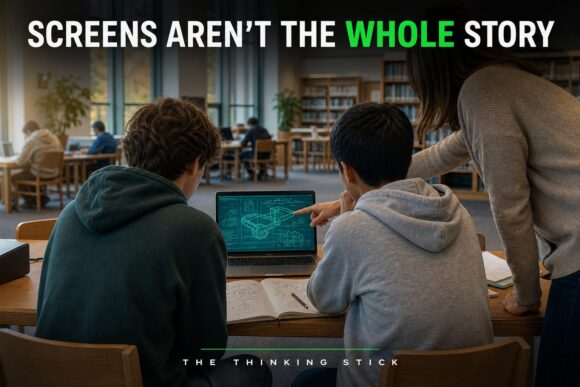
Here’s what’s interesting. This study split screen use a different way, into passive and interactive, and found the interactive stuff carried the clearer link. That’s a good reminder that “interactive” isn’t automatically “active learning.” Gaming and chatting at midnight is interactive. So is designing a robot in a library with your teacher. Same category, very different experience. The study couldn’t tell those apart, and the researchers say their next step is to look at content, motivation, problematic use and what screen time replaces. That’s exactly the right question.
Which brings me back to policy. When a district writes a rule that caps daily minutes on a school device, what is it actually measuring? Time. Not purpose. Not quality. Not what the student was learning or making. And the research we got this week says time alone is a weak signal.
Who’s setting the habits? That’s the other half of this. If shared family factors explain a big part of the link, then the conversation about kids and screens has to include the adults. Genes, home routines, stress, sleep, how parents use their own devices…. the study can’t sort out which of those matters most, but it tells us the family is part of the picture. I wrote about this in Parenting In A Digital Age, and it’s still true: kids learn their digital habits by watching us.
This is why I keep saying our job is preparing students for their future, not our past. Their future is full of screens. Their jobs, their relationships and their civic life will all run through them. A rule that removes screens can buy some calm. It can’t teach a 15-year-old how to notice when six hours of gaming is crowding out sleep and friends. Only teaching does that.
I make this argument a lot with school leaders. In Human Still Required, I write about how the tools keep changing but the leadership work doesn’t: judgment, relationships and trust. “Different tools. Same leadership work.” A screen-time policy is a leadership decision. It deserves the same judgment we’d bring to any other decision about student well-being, not just a number someone can count.
What schools can do this week
- Ask what, not just how long. Before your next tech policy conversation, list how students actually use school devices in a typical week. Creating, practicing, researching, watching, scrolling. Then decide which of those you want more of and which you want less of.
- Look for heavy use, not average use. The clearest risks in this study showed up among the heaviest users. Counselors and advisors can ask students about late-night use, sleep and gaming in their regular check-ins, the same way they ask about attendance.
- Bring families into the conversation. Host a session that isn’t a lecture about kids’ phones. Talk about the whole household’s habits, including the adults’. The research says the family is part of this story.
- Teach the connect and disconnect skill. Build in lessons where students track their own use, reflect on how they feel, and set a goal. That is a skill they’ll use for the rest of their lives.
- Read the study before you cite it. If a board member, parent or vendor sends you a headline about screens, ask for the study, the sample and the limits. Model the critical thinking we want from students.
Frequently asked questions
Does screen time cause depression and anxiety in teens?
The research doesn’t give a clean answer. This new twin study found that heavy interactive screen use at 15 was linked to later depression and anxiety, but much of that link weakened when twins in the same family were compared. That suggests shared family and genetic factors explain a big part of it, though a smaller direct effect can’t be ruled out.
Is all screen time the same for kids?
No. In this study, interactive activities like gaming, chatting and browsing showed clearer links to later mental health problems than passive viewing like TV and videos. Neither category tells you whether a student was learning, creating or just killing time, which is why what kids do matters as much as how long.
Should schools set daily screen time limits?
Limits can help when they target clearly unhealthy use, but a minute cap alone measures time, not purpose. Schools will get more from deciding which kinds of device use support learning, teaching students to manage their own habits, and working with families on what happens at home.
I’m glad researchers are doing this careful work. I’m glad districts are taking student well-being seriously, too. I just want those two things to meet in the middle, with policies built on what students are doing and who’s around them, not a stopwatch.
If your school or district is working through screen time and AI policy right now, this is the work I do with leaders every week. You can find me at JeffUtecht.com.
So I’ll ask: when your school talks about screen time, are you measuring minutes, or are you asking what students are actually doing?
Sources
- Recreational screen use and internalizing problems from preadolescence to young adulthood in a longitudinal twin cohort with co-twin comparison — Gong, Lu et al., Nature Human Behaviour, October 8, 2026
- Twin study sheds new light on screen time and mental health — Karolinska Institutet, October 8, 2026
- Statewide: Schools and screentime — Sean Crawford, NPR Illinois, October 8, 2026