The fight over E-Rate and screen time reached a turning point this week, and The 74 laid out where it stands: nearly 3,200 comments landed at the FCC by the October 13 deadline, and most of them told the commission the same thing. Don’t cut the program that pays for school and library internet.
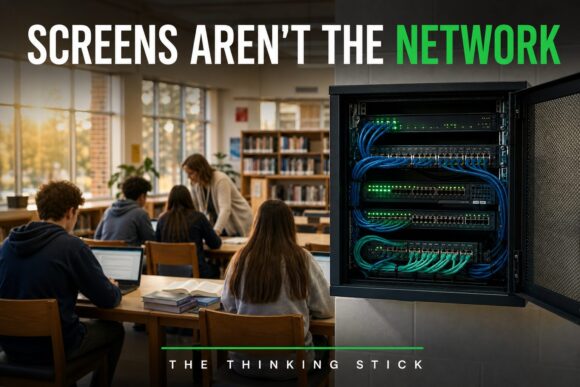
Here’s the thing that keeps bugging me. Part of the case for reviewing E-Rate has been built on concern about how much time kids spend on screens. I share some of that concern. But the network in the wall is not the screen in a student’s hand, and treating them as the same thing is going to hurt the students who can least afford it.
Key takeaways
- The FCC’s review of E-Rate asks whether the program should be limited or sunset, and it ties part of that question to concerns about children’s screen time.
- E-Rate pays for connectivity, not devices, software or online content, so cutting it does not change what students do on screens.
- The school network also runs security, payroll and nutrition systems, and E-Rate discounts reach up to 90% in low-income communities.
- Screen time is a teaching and policy question for schools and families. It is not a reason to pull the plug on the infrastructure.
What’s happening with E-Rate and screen time
E-Rate is the roughly 30-year-old federal program that discounts internet service for schools and libraries. In June, FCC Chairman Brendan Carr called for a “top-to-bottom” review and for “right-sizing” the program, and linked it to concerns about students’ excessive screen time, according to Linda Jacobson at The 74 (October 20). The FCC’s June notice asks directly: “Should the E-Rate program be limited or sunset to reflect today’s extensive connectivity rates?” It also says that “research suggests that heightened screen time may be related to negative outcomes among children,” and asks whether parents should be able to opt their kids out of screen-based instruction.
To be fair to the process, the commission is asking questions, not flipping a switch. FingerLakes1.com put it plainly: the FCC “is seeking comment on possible changes, not implementing a cutoff.” Reply comments are open until November 12.
The response has been lopsided. E-Rate Central’s October 19 review of the docket counted 3,000 or more filings and found that none of the responses from E-Rate applicants or suppliers supported cutting funds. The opposition, it noted, came almost entirely from individuals who, when they got specific, focused on screen time or screen-based education.
Lawmakers weighed in too. FingerLakes1.com reported (October 20) on an October 15 letter to Carr from Sen. Kirsten Gillibrand, Sen. Chuck Schumer, Reps. Doris Matsui, Rob Menendez and Grace Meng, and more than 60 other House Democrats. They pointed out that E-Rate reaches more than 96% of U.S. public schools, that more than 158,000 schools and libraries used it in 2025, and that discounts run from 20% to 90% based on things like rural status and the share of students eligible for school lunch help. Their argument: screen-time concerns are real, but they should be handled without pulling broadband discounts, and device decisions belong with state and local policy.
I’ll admit the screen time worry is fair. Here’s what it leaves out.
Let me give the other side its strongest form. One parent quoted by The 74, Sandhya Polu, wrote that her family keeps a “minimum screen household,” that she tried and failed to opt her son out of classroom technology, and that ed tech lacks “credible, independent evidence of educational benefit.” Thomas Schatz of Citizens Against Government Waste argued for eliminating “duplication of broadband services.” A Senate Commerce Committee report raised concerns that consultant pay structures can reward higher spending.
Those are reasonable things to ask about. Parents should have a real voice in how their kids use technology at school. Programs that spend public money should be able to show what they buy. I’ve never argued that every screen minute in school is a good one.
But look at what E-Rate actually pays for. Per The 74, its discounts don’t apply to devices or software at all. It pays for the connection, and that connection runs a lot more than student laptops: security, payroll and nutrition systems. Kimberley Dunn Lewis of the Minnesota School Boards Association put it simply: “E-Rate helps provide the network infrastructure that keeps Minnesota’s school districts running.”
Take away the discount and the screens don’t go away. The bill just moves. Amanda Kordelski of Norman Public Schools in Oklahoma told the FCC that E-Rate saves her district about $3.9 million a year, and absorbing that would mean losing teaching positions. Read that again. A policy pitched as protecting kids from screens could end with fewer teachers in front of them.
And who feels that first? The discounts reach up to 90% in low-income communities. A well-funded suburban district can probably find the money somewhere. A rural district or a high-poverty urban one has a lot fewer places to look. I wrote The New Digital Divide back in 2005, and Inequity Should Not Equal Inaction in 2020. Twenty years later, access still comes first.
We have a choice. They don’t.
The bigger problem is the logic underneath this. “Screens are hurting kids, so let’s reduce the pipe” treats all screen time as the same thing. It isn’t. Back in 2010 I wrote about Active vs Inactive Screen Time, and the distinction still holds. A student researching a local water issue, writing for a real audience or building a portfolio is not doing the same thing as a student scrolling a feed. One of those needs a fast, reliable network at school. The other doesn’t need the school at all.
Adults get to decide how much technology is in their lives. Students don’t get that choice about their future. The jobs, the colleges, the civic life they are walking into all run on connectivity and on knowing how to use it well. If school is the place where we teach them when to connect and when to disconnect, we need the connection to teach with.
Preparing students for their future, not our past, means we teach the habits. We don’t pretend the tools aren’t there.
Banning and blocking teaches nothing. Teaching does. Limiting the network is a blunt way of saying “we don’t trust schools to make good choices,” when the actual fix is helping schools make better ones and showing families what those choices are.
This is the kind of leadership work I focus on in Human Still Required. The questions about technology and kids are human questions about judgment, trust and accountability. Different tools. Same leadership work.
What schools can do this week
- Know your number. Find out what your district or library received through E-Rate last year and what it would cost to replace. Share it with your board and your community in plain language.
- Map what runs on your network. Instruction, yes, but also security, payroll, nutrition and testing. Most families have no idea how much of a school day depends on the connection.
- Separate the two conversations. Write (or revisit) a clear, public screen-use approach for each grade band that names active vs. inactive use. That is where the screen time conversation belongs.
- Invite parents in. If a parent wants to understand or limit their child’s screen use, have a real process and a person they can talk to. Concern ignored becomes support for blunt policy.
- Consider a reply comment. The FCC is taking reply comments until November 12. Specific, local, factual stories matter more than form letters.
Frequently asked questions
What is E-Rate and what does it pay for?
E-Rate is a federal program, about 30 years old, that discounts internet service for schools and libraries. Discounts range from 20% to 90% depending on factors like rural status and student poverty. It pays for connectivity, not devices, software or online content.
Is the FCC ending E-Rate?
Not as of this writing. The FCC opened a review in June that asks whether the program should be kept, narrowed or sunset, and it is still taking comments. Reply comments are due November 12.
Would cutting E-Rate reduce students’ screen time?
Not directly. Because E-Rate funds the network rather than devices or content, cutting it shifts the cost of connectivity to districts and local taxpayers. How much students use screens at school is decided by school, state and family choices, which is where that conversation should happen.
I’m not saying we stop asking hard questions about screens in school. We should keep asking them, and schools should be ready to answer. But the answer to “are kids using technology well?” is better teaching and clearer choices, not a weaker connection.
If your school or district is working through screen time, AI and what it all means for students, that’s the work I do with leaders every week. You can find me at JeffUtecht.com.
So what would happen in your school if the E-Rate discount went away tomorrow, and does your community know?
Sources
- Educators Ask FCC to ‘Preserve and Strengthen’ Broadband Discount Program — The 74, Linda Jacobson, October 20, 2026
- Gillibrand urges FCC to keep school and library internet discounts — FingerLakes1.com, Staff Report, October 20, 2026
- News of the Week: October 19, 2026 — E-Rate Central, October 19, 2026