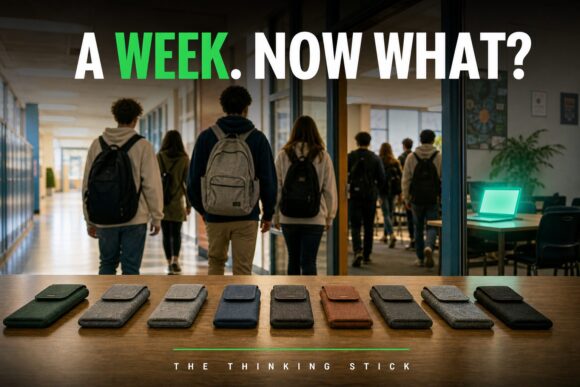
The study a lot of us have been waiting for dropped this week. Researchers at Harvard and Dartmouth, working with NWEA, looked at what happened to learning when schools locked students’ phones in pouches all day. If you have been following the debate over cell phone bans in schools, you probably saw the headline: strict bans add the equivalent of one to two weeks of learning a year.
My first reaction? Good. I mean that. A real, national, student-level study is exactly what this conversation has needed. My second reaction took a little longer. One to two weeks is real, and it is also small. So if phones are worth a week or two… what is going on with the rest of the year?
That second question is the one I want to sit with.
Key takeaways
- A new Harvard/Dartmouth study of about 3.3 million students found strict, pouch-based phone bans raised math and reading growth by about 0.01 standard deviations a year, roughly one to two weeks of instruction.
- The researchers themselves call the gain modest, and outside researchers called the results small and sensitive.
- A phone ban is a reasonable, low-cost step. It is not an explanation for a decade of declining achievement, and it is not a plan for teaching students how to live with technology.
- The bigger questions are out-of-school use, what students do on the devices schools hand them, and whether we are teaching habits or just locking things up.
What the new study on cell phone bans in schools found
Here is the short version, pulled from three good write-ups of the report released on November 17: Erica Meltzer at Chalkbeat, Kevin Mahnken at The 74 and Anna Merod at K-12 Dive.
- The data: NWEA MAP Growth math and reading scores for about 3.3 million students across roughly 4,600 schools, from 2021–22 through 2025–26. The 74 notes it covers grades 4–10 and compares schools with strict bans to otherwise-similar schools without them.
- The policy studied: strict bans where phones go into lockable pouches, mostly from Yondr, which Chalkbeat reports cost about $25 to $30 per student.
- The effect: about 0.01 standard deviations of extra growth a year in reading and math. The researchers describe that as one to two weeks of instruction, or about half of the annual pre-pandemic decline. The 74 put it as about two extra minutes per hour of class time.
- Who benefited: Chalkbeat reports the gains were similar across elementary, middle and high schools and across schools with different poverty and achievement levels. There was no evidence that the lowest-achieving students gained more, which co-author Tom Kane called disappointing. Strict bans did reduce the number of students with large losses in reading.
- Phone use: The 74 reports the pouches cut phone activity by about 20 percent, a measure Kane says may understate the effect.
Kane, the Harvard economist who led the work, made the case for bans plainly:
A strict cell phone ban is a low-cost way to add one to two weeks of instruction per year.
Tom Kane, Harvard, via Chalkbeat
He also connects it to a bigger story. In the K-12 Dive coverage, Kane points out that U.S. achievement started sliding around 2013, the same years smartphones spread among teens, and says strict bans “seem to plug about half of that leak.” That is a fair argument, and I want to state it in its strongest form: if phones are part of the decline, getting them out of the school day should help, and this study says it does, a little, every year, across lots of different schools.
I take that seriously. I also think the researchers were unusually honest about the limits, and the limits are where the story gets interesting.
Here’s what the headline leaves out
Read past the headline and the people closest to the data are careful. Kane himself called the gain “modest” and told The 74 that “one or two weeks is no big deal on a one-year basis”; what matters is whether small gains persist. Stanford’s Thomas Dee, whose earlier national study found negligible academic effects, called these sobering results and said they “fall short of the ambitions many of us had for school phone bans.”
Then Dee offered two possible explanations in an email to The 74. One is that bans don’t go far enough, because students still use laptops in school and phones outside of school. The other:
Or it may be that students’ phone use in schools simply isn’t the child-development problem we thought it might be.
Thomas Dee, Stanford, via The 74
I don’t know which of those is right. Neither do the researchers, and they say so. Kane called out-of-school phone use “a black box” and said, “We’re 13 years into this, and nobody has strong evidence.”
Here’s the thing. That sentence should slow all of us down. For years the public story has been that phones and screens are ruining a generation and dragging down test scores. This week we got the best evidence yet on the in-school piece, and it says a strict ban is worth something real but small. That means most of the decline we’re worried about has to be explained by something else, or by something a pouch can’t reach.
So what else? This study doesn’t answer that, and I won’t pretend it does. But these are the questions I’d want every board and every parent group asking before they decide the phone fight is the main event:
- How many of our students are actually in class every day, and what has happened to that number since 2020?
- What are students doing on the school-issued laptop that never goes in a pouch? Is that active, creative work or passive scrolling with a different logo on it?
- What happens to the habits we say we care about at 3:15, when the pouch opens and nobody is teaching anything?
- Have our teachers been given time and training to design learning that is worth putting the phone down for?
None of those questions say phones are fine. They say the story is bigger than the phone. I wrote about the difference between kinds of screen time back in 2010 in Active vs Inactive Screen Time, and I still think it is the distinction this debate keeps skipping. A student building a model, writing for a real audience or coding is not doing the same thing as a student doom-scrolling, even though both count as “screen time.”
We have a choice. They don’t.
Let me concede the obvious. If your school has a pouch policy and it is working for your teachers, I’m not telling you to rip it out. This study gives you a reasonable case that it is helping a bit. Cheap, steady and positive is not nothing.
What worries me is what we stop doing once the pouch goes on. A ban is a control. It isn’t a lesson. Students are going to graduate into a world where the phone, the laptop and now AI are in every job and every relationship they have. Adults have a choice about how much technology we use. Our students don’t, because their future runs on it. I made that argument in 2016, and it matters even more now.
If the most we do is lock devices away for seven hours, we haven’t taught a single student when to connect and when to disconnect, or why. We’ve just moved the problem to after school, where Kane says we have the least evidence and the least control. That is the part of this that is ours to fix as educators: preparing students for their future, not our past.
This is the same pattern I see with AI right now. The reflex is to block, ban and wait. In Human Still Required, I argue that the tools change but the leadership work doesn’t. Different tools. Same leadership work. A phone policy is a tool. Teaching judgment, building trust with students and designing learning that matters is still the work.
What schools can do this week
- Share the actual numbers with your community. Tell families what this study found, including the “modest” part. Honest expectations now prevent disappointment later.
- Pair any ban with teaching. Build short, regular lessons on attention, notifications and when to put a device away, and have students talk about why. A pouch can hold a phone; it can’t hold a conversation.
- Audit the screens you control. Pick one grade level and look at a week of what students do on school devices. How much is active creation, and how much is passive?
- Look at attendance next to achievement. Before you credit or blame any single policy, put your own attendance data beside your test data and see what story it tells.
- Bring students into the policy. Ask them what helps them focus and what doesn’t. They are the ones who will have to manage this without us.
Frequently asked questions
Do cell phone bans in schools improve test scores?
According to the Harvard and Dartmouth study released November 17, 2026, strict pouch-based bans were linked to about 0.01 standard deviations of extra growth in math and reading per year, roughly one to two weeks of instruction. The researchers call that modest, and an earlier national study from Stanford’s Thomas Dee found negligible academic effects.
Are phones the reason test scores have declined?
Not on this evidence alone. Kane links the decline that began around 2013 to the spread of smartphones and says strict bans plug about half of the annual pre-pandemic decline. But he also said nobody has strong evidence on out-of-school phone use, and Dee suggested in-school phone use may not be the problem many expected. It’s fair to treat phones as one factor, not the whole explanation.
Should my child’s school keep its phone ban?
If the ban is working for teachers and students, this study gives a reasonable case that it helps a little at low cost. The bigger question is what the school teaches alongside it: how to manage attention, notifications and devices, so students have those habits when the pouch opens.
The rest of the year
I’m glad we have this study. I’m glad the researchers were honest about it. And I hope it moves us from arguing about whether phones are the villain to asking better questions about the other thirty-plus weeks of the school year, and the hours after school, where most of learning and most of growing up actually happens.
If your school or district is trying to figure out what comes after the ban, that is exactly the kind of work I do with leaders every week. You can find me at JeffUtecht.com.
So here’s my question for you: if your school has a phone ban, what are you teaching students alongside it?
Sources
- A Yondr pouch might be as effective as an extra week of learning, new cell phone ban study finds — Chalkbeat, Erica Meltzer, November 17, 2026
- Phone Bans Improve Learning, Study Finds — But So Far, Only Slightly — The 74, Kevin Mahnken, November 17, 2026
- Are strict school cellphone bans working? — K-12 Dive, Anna Merod, November 17, 2026