There’s one line in a new Northeastern University report on AI and hiring that I keep coming back to: “increasingly, software reads the résumé before a person does.” If that’s true (and the data says it is for a lot of employers), then I think it changes how we should be talking about student digital portfolios in K-12. Not as a nice extra. As the main way a young person shows who they are and what they can do.
Here’s the thing. For years we’ve prepared students to describe themselves on a single page. A list of classes, a GPA, a club or two, maybe a part-time job. Now that page gets read by an algorithm first, and the entry-level job on the other side of it expects more judgment than it used to.
So what will our graduates actually be able to show?
Key takeaways
- A Northeastern University survey of 8,174 U.S. hiring decision-makers found 54% use AI to screen résumés, rising to 83% in information and technology.
- Among hiring decision-makers who say AI has changed how they hire, 26% are hiring fewer entry-level workers and 28% expect entry-level staff to do more or higher-level work.
- Microsoft’s Katy George told an Axios audience that early-career roles can be redesigned, but new workers will have to build judgment and perspective much faster.
- Schools can respond by helping every student build a portfolio of real work for real audiences that shows their thinking, including how and why they used AI.
What’s happening: AI is in the hiring room
On November 1, Northeastern’s Institute for Information, the Internet & Democracy released AI in the Hiring Room: What America’s Hiring Decision-Makers Think About AI, by John Wihbey, David Lazer, Ata Aydin Uslu and Alisa Zomer. It draws on a nationally representative survey of 38,375 adults fielded this summer and zooms in on the 8,174 people who said they can hire staff or significantly influence hiring.
A few findings stood out to me:
- 47% of hiring decision-makers say AI has changed how they hire. That’s a lot, but it also means the shift is not universal, and the report says so directly.
- 54% use AI tools to screen résumés at least to some extent. At employers with 500 or more workers it’s 68%. In information and technology it’s 83%.
- Among those whose hiring has changed, 26% are hiring fewer entry-level workers because of AI and 7% are hiring more. Another 28% are hiring about the same number but expect entry-level staff to do more, or higher-level, work with AI. 38% report no change.
- If a candidate had used AI for all of their writing or coding assignments in school, 40% say that would encourage them to hire, 21% say it would discourage them, and 39% say it would make no difference.
- 38% say a college degree is now more valuable for entry-level hires since the rise of AI. 40% say it’s about the same, and 16% say it’s less valuable.
Northeastern Global News reporter Katya Poltorak wrote up the findings on November 2 in a piece on how AI is changing what’s in store for new hires and managers. Wihbey told her, “The fears around entry-level jobs are real.” The same article quotes employment lawyer Gary Friedman of Seyfarth Shaw, who put the choice in front of employers about as clearly as I’ve seen it: “AI can hollow out the bottom rung of the ladder or it can turn it into an escalator.”
A few days earlier, on October 28, Axios hosted a live event here in Seattle on the same question. In Axios’ recap of how employers are rethinking AI’s role in entry-level work (October 30), Microsoft corporate vice president Katy George described automating traditional “grunt work” and said, “What we can do instead is to redesign the early career to, frankly, make them more interesting jobs.” Then came the catch: “But it requires [entry-level workers] to actually level up in terms of judgment and perspective much faster.”
To be fair, Axios also noted that Microsoft is reportedly offering voluntary buyouts to about 60,000 employees, roughly a quarter of its global workforce, so the “we’re still hiring” message comes with some tension. And Laura Ruderman of the Technology Alliance said something on that stage that every school leader should hear: “I hear a lot from educators now that critical thinking and all of those soft skills are coming back into vogue.”
Why student digital portfolios matter more now
Let me be careful here. This survey does not say the résumé is dead, and it doesn’t say employers are asking for portfolios. Most hiring decision-makers report no change or steady entry-level hiring. Plenty still value a degree. Nearly half (46%) say they don’t even look for AI skills. If you’re a school leader who reads this and thinks “so not much has changed,” I understand that reading.
But put the pieces together. Software is often the first reader. The applications are piling up (the Northeastern article cites Greenhouse data showing application volume has more than doubled since 2022). And when the job is redesigned, the person in it is expected to bring judgment sooner. A one-page list of what a student took doesn’t show judgment. Work does.
I’ve been saying a version of this for a long time. Back in 2010 I wrote about blogs as web-based portfolios, and in 2013 in Millennials and the Job Market I argued that a public digital portfolio and real work for real audiences would matter more than a paper résumé. The tools have changed. The argument has only gotten stronger.
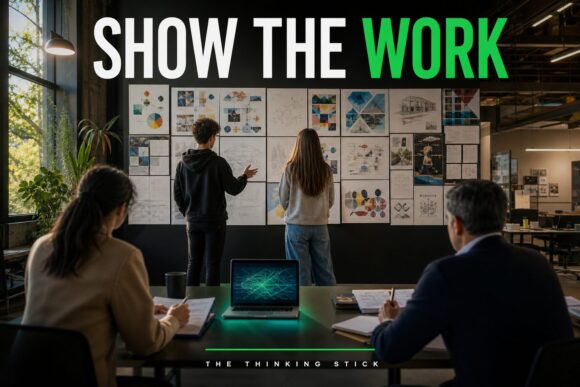
When an algorithm and then a busy human both have a few seconds with you, what helps is a body of work someone can actually look at. A project you built for a local business. A data analysis you presented to the school board. A piece of writing that went through four drafts and you can explain why. That’s the evidence a résumé can only claim.
Preparing students for their future, not our past, means preparing them for a hiring process where they will be read by software, asked to show judgment early, and expected to explain their work.
The AI question every graduate will have to answer
The finding I’d put in front of every high school staff meeting is that 40 / 21 / 39 split. Employers do not agree on what it means when a student used AI for all their schoolwork. Some see it as a plus. Some see it as a red flag. A big group doesn’t care.
What does that tell us? I’d argue it tells us the question isn’t really “did you use AI?” It’s “how did you use it, and can you explain your thinking?” A student who can say, “I used AI to get a first draft of the code, it broke in these two places, and here’s how I figured out why,” is showing exactly the judgment Katy George was talking about. A student who can’t explain how their work was made is a risk no matter which camp the employer is in.
This is where schools have real work to do. In Human Still Required I argue that “AI didn’t break school — it exposed it.” Hiring is exposing the same thing. If our assignments can be completed without judgment, they can be completed without the student. Portfolios that show process, drafts, decisions and reflection are one of the best ways I know to make the thinking visible again.
What schools can do this week
- Pick one course or grade level and start a portfolio habit. Not a once-a-year showcase. One piece of work a month, posted with a short reflection: what I made, who it was for, what I’d change.
- Ask students to document their AI use. A simple line on each assignment: what tool, what for, what I changed, what I checked. Practice now means a confident answer in an interview later.
- Find one real audience. A local employer, a city department, a nonprofit or your own district office. Ask for one problem students can work on and present back.
- Review your graduate profile against the evidence. If your portrait of a graduate says “critical thinker” and “communicator,” where does a student show that? If the answer is a transcript, that’s a gap.
- Invite an HR or hiring manager into a staff meeting. Ask them how their résumé screening works now and what they wish candidates could show. Then listen.
Frequently asked questions
Do employers actually look at student digital portfolios?
Some do and some don’t, and the Northeastern survey didn’t ask about portfolios directly. What it does show is that AI often screens résumés first and that many employers expect entry-level hires to bring more judgment. A portfolio gives a student concrete examples to point to in an application, an interview or a conversation with a mentor.
Will using AI on schoolwork hurt my child’s job chances?
Employers are split. In the Northeastern survey, 40% of hiring decision-makers said heavy AI use in school would encourage them to hire, 21% said it would discourage them and 39% said it made no difference. The safest skill is being able to explain how and why you used AI and what you did to check its work.
What should a high school portfolio include?
Real work for real audiences, with the thinking showing: drafts, decisions, feedback received and what changed. Projects with community partners, internships or work-based learning, and a short reflection on each piece are a strong start. Quality and explanation matter more than volume.
I don’t think the sky is falling on entry-level work, and this survey doesn’t say it is. But it does say the first rung is changing, and the first reader is often a machine. Our students deserve to walk into that with more than a list.
If your school or district is working through what a graduate should be able to show in an AI-shaped job market, this is the work I do with leaders every week. You can find me at JeffUtecht.com.
So here’s my question for you: if an employer looked at your students’ work tomorrow, not their transcripts, what would they find?
Sources
- AI in the Hiring Room: What America’s Hiring Decision-Makers Think About AI — Institute for Information, the Internet & Democracy, Northeastern University (John Wihbey, David Lazer, Ata Aydin Uslu, Alisa Zomer), November 1, 2026
- Fewer jobs, new opportunities: AI is changing what’s in store for new hires and managers alike — Northeastern Global News, Katya Poltorak, November 2, 2026
- Axios Live: How employers are rethinking AI’s role in entry-level work — Axios (via Yahoo Finance), Claire Moberg, October 30, 2026