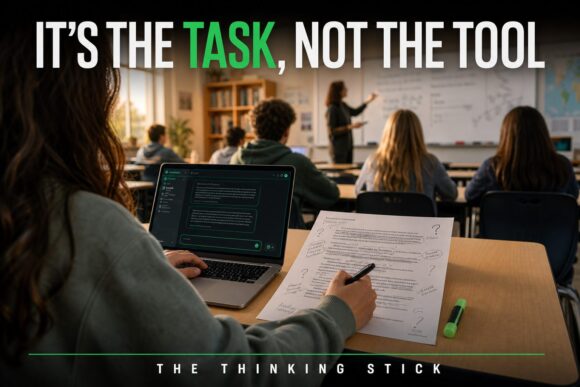
Two things landed in my reading this week that belong together. One says the AI being built into our curriculum products mostly hasn’t proven it helps kids learn. The other says that when it comes to AI and critical thinking, the tool matters a lot less than the task we put in front of students.
Put those side by side and you get a story that is a lot more useful than the one in most headlines. The headline version is “AI is making kids stop thinking.” The version the evidence supports is closer to this:
AI does what we design it to do. And right now, a lot of it isn’t being designed for thinking at all.
Here’s the thing…. Those are two very different problems, and they need two very different responses.
Key takeaways
- A new EdReports review of 10 curriculum and edtech vendors found that only one included third-party evidence that its embedded AI features improved learning outcomes.
- A systematic review of 67 studies of ChatGPT in higher education found its effect on thinking depended on instructional design: scaffolded, inquiry-based tasks supported reflection, unstructured use encouraged offloading.
- Whether AI helps or hurts critical thinking is mostly a design question, not a technology question.
- Schools should ask vendors for evidence and ask themselves whether their own assignments require students to question, verify and revise.
What’s happening: two reports, one story
On September 29, EdSurge’s Ira Apfel reported on a new EdReports study of AI in K-12 instructional materials. EdReports, the nonprofit that reviews pre-K–12 curriculum, looked at AI-enabled products from 10 vendors: four of the top 10 publishers of instructional materials, three mid-sized curriculum providers and three digital-first edtech companies. The finding that jumped out at me: only one of the 10 included third-party evidence that the AI features they embedded improved educational outcomes.
I knew that there wasn’t going to be much evidence, but I was surprised at how little there was.
Courtney Allison, chief academic officer, EdReports, quoted in EdSurge
The article also points to a transparency problem. Even figuring out whether materials contain AI can be hard, because it can be introduced without notification from the vendor. Matt Moyer, principal of Rupert Elementary School in Pennsylvania, told EdSurge that some tools his school was already using had AI built in that they “simply hadn’t been told about.” Lora Kaiser of the Center for Education Market Dynamics put the question every district should be asking simply: “Is it a feature I can opt in to?”
The next day, the EdSurge podcast went deeper with Allison and EdReports CEO Lewis Ferebee, including a distinction I think matters a great deal: some AI features let teachers review content before it reaches students, while others deliver content directly to students in real time.
Then on October 1, Michelle Miller, who teaches at Northern Arizona University, used her R3 newsletter to walk through a new systematic review on ChatGPT and critical and creative thinking. The review, by Li, Cui and Serra in Computers and Education: Artificial Intelligence, pulled together 67 empirical studies. One honest caveat: every one of those studies was in higher education, with undergraduate or graduate students, not K-12. Still, the pattern is hard to ignore. When tasks and classroom norms required verification, justification and revision, students were more likely to treat AI output as something to interrogate. Without that structure, the tool encouraged cognitive offloading and surface-level engagement.
Miller’s summary of it is the line I keep coming back to:
…the same exact tool can become a shortcut machine or a thinking partner depending on whether students are asked to question it, revise with it, verify its output.
Michelle Miller, R3 newsletter, October 1, 2026
AI and critical thinking: here’s what the headline leaves out
I want to be fair to the people who are worried. The worry is reasonable. When a tool can produce a passable essay in seconds, of course some students will use it to skip the thinking. Plenty of teachers have watched it happen. And the EdReports finding should make all of us uncomfortable. If vendors are putting AI in front of kids without evidence that it helps, and sometimes without telling the school it’s there, caution is the right response.
But notice what neither report says. Neither one says AI causes students to stop thinking. One says we don’t have evidence the AI in our products is helping. The other says the effect on thinking depends on how the task is designed.
That second finding should feel familiar to anyone who has been around educational technology for a while. I lived through the 1:1 laptop rollouts in international schools. Some schools handed every student a device and changed nothing else. Others redesigned the learning. Same laptops. Very different results. I wrote about this back in 2009 in What’s the purpose of going 1:1, and the question in that title is the same question we should be asking about AI today.
If an assignment can be completed by pasting the prompt into a chatbot, what was that assignment measuring in the first place?
That’s uncomfortable, but it’s the real conversation. A worksheet that asks students to summarize a chapter was never really a critical thinking task. AI just made that obvious. This is what I mean when I say “AI didn’t break school — it exposed it.” In Human Still Required, I argue that the judgment about what students should do, and why, has to stay with educators. The tool can draft. It can’t decide what learning is for.
Two problems, two different fixes
Here’s the distinction I’d offer school leaders. There is AI we buy and AI we design for.
AI we buy is the AI inside curriculum platforms and edtech products. That’s a procurement and accountability problem. The EdReports study says the evidence isn’t there yet, so the burden belongs on vendors. Ask for it. Ask what the study sample was. Ask whether the feature can be turned off. Ask whether a teacher sees the content before a student does.
AI we design for is what happens in a classroom when students use AI as part of a task. That’s a teaching and learning problem. The research Miller highlighted says the difference between a shortcut and a thinking partner is the structure around the tool: questioning it, verifying it, revising with it, explaining your choices.
Banning AI solves neither problem. A ban doesn’t make a vendor produce evidence, and it doesn’t teach a single student how to question a machine’s answer. Students are going to use these tools in college and at work. We have a choice about that. They don’t. Preparing students for their future, not our past. That’s the job, and it means teaching them to think with and against AI, not pretending it isn’t there.
And to be clear, I’m not saying every AI feature belongs in every classroom. Some don’t. A real-time AI feature talking directly to a seven-year-old with no teacher in the loop deserves a much higher bar than a tool that helps a teacher draft a rubric. Different uses deserve different scrutiny.
What schools can do this week
- Inventory the AI you already have. Ask your curriculum and edtech vendors, in writing, which features in your current products use AI. Based on the EdReports findings, don’t assume you already know.
- Ask for evidence, not badges. When a vendor claims its AI improves learning, ask for the study, the sample size and who conducted it. Third-party evidence was rare in the EdReports review, so ask directly.
- Sort features by who sees the output first. Teacher-reviewed AI and AI that talks directly to students are not the same risk. Set your expectations accordingly.
- Run one assignment through the “paste test.” Pick an assignment and ask: could a chatbot complete this without the student thinking? If yes, redesign it so students must verify, justify or revise, and explain their choices.
- Teach the verify step out loud. Model in front of students how you check an AI answer: what you doubted, what you looked up, what you changed. Thinking you can see is thinking students can copy.
Frequently asked questions
Does AI hurt students’ critical thinking?
The research so far says it depends on how AI is used. A 2026 systematic review of 67 higher education studies found that unstructured use encouraged cognitive offloading, while tasks that required verification and revision supported deeper thinking. The research base for K-12 is thinner, so schools should watch closely and design carefully.
Is there evidence that AI in curriculum products improves learning?
Not much yet. In a recent EdReports review of 10 curriculum and edtech vendors, only one provided third-party evidence that its embedded AI features improved educational outcomes. That doesn’t mean the features don’t work. It means schools can’t know yet, and should ask.
Should schools ban AI to protect critical thinking?
A ban may feel safer, but it doesn’t teach students how to evaluate AI output, which they will need after graduation. A stronger approach is to be selective about which AI products reach students and to design assignments that require students to question, verify and revise what AI produces.
The question isn’t whether. It’s how.
We’ve had this argument before, with calculators, with the internet, with laptops. Every time, the schools that did well were the ones that asked what the tool was for and redesigned the learning around it. The tool never did the thinking for them. Yes… it’s more work. It always is.
If your school or district is sorting out which AI belongs in front of students and how to design for real thinking, that’s the work I do with leaders every week. You can find me at JeffUtecht.com.
So here’s my question for you: if you ran your last three assignments through the “paste test,” how many would pass?
Sources
- Study: EdTech Is Rushing AI Integration Before Proving It Works — EdSurge, Ira Apfel, September 29, 2026
- Can Schools Trust AI Features in Edtech Products? — EdSurge Podcast, September 30, 2026
- R3 4.9: Critical Thinking, Creative Thinking, and AI — Michelle Miller, Ph.D., R3 newsletter, October 1, 2026 (discussing Li, Cui & Serra, 2026, Computers and Education: Artificial Intelligence)