I keep reading headlines about what Gen Z wants at work, and most of them sound like the same story: unlimited PTO, remote everything, a ping-pong table and a manager who never pushes back. Then a new study lands and the story falls apart. This week it was the turn of SHRM and Fidelity Investments, and the answer they got from young workers was a lot more ordinary than the headlines. Fairness. Job security. A good manager. Clear expectations.
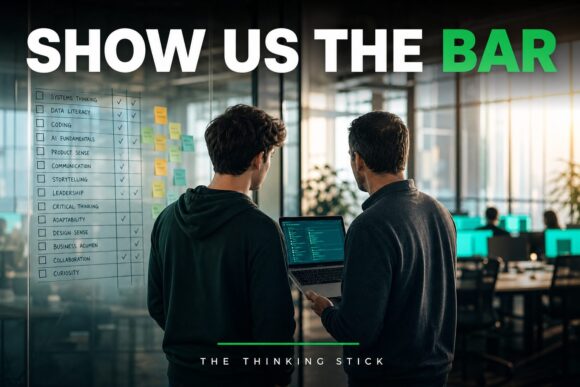
Put that next to two other reports that came out the same week, both about hiring, and a pattern jumps out. Young people are asking for one thing over and over: show us the bar. Tell us what good looks like, treat us fairly while we try to reach it, and give us a real chance to prove we can.
Here’s the thing… that’s not a Gen Z request. That’s a human request. Gen Z is just the generation saying it the loudest right now.
Key takeaways
- A new SHRM and Fidelity study finds young workers rank a fair, respectful workplace (86%) and job security (85%) at the top of what keeps them in a job.
- Only 27% of HR leaders in the same study think job security matters to younger workers, a big perception gap.
- Job seekers describe hiring as a black box: Greenhouse found 38% of Gen Z applicants are often or almost always rejected without talking to anyone.
- Leaders can close the gap by making the bar visible: name the skills, explain the standard, and give young people a way to show their work.
What’s happening: three reports, one message
Start with the study. In a Forbes piece on what young workers really want (October 25, 2026), Bryan Robinson walks through research SHRM and Fidelity Investments released on October 22. They surveyed 1,005 workers ages 18–26, 505 workers ages 27–80 and 1,010 senior HR professionals. Robinson is careful to point out that the samples weren’t weighted, so the numbers may not represent every U.S. worker, and the young group covers only ages 18–26, not all of Gen Z. Fair enough. Still, the results are worth sitting with:
- 86% of young workers say a fair and respectful workplace is important to keeping a job.
- 85% say job security matters. Only 27% of HR leaders think it matters to younger workers.
- 80% name work-life balance, and 80% name a good relationship with their manager.
- 77% say clarity about their job responsibilities is important.
- 70% cite cost of living as a current challenge.
- On where they work: 42% prefer in person, 41% hybrid and 17% fully remote.
Read that last one again. The “they all want to work from home” story doesn’t hold up in this data either.
Now the hiring side. HR Dive reported on October 23 on a Greenhouse survey of more than 2,800 job seekers in the U.S., U.K., Ireland, Germany and Australia. 81% had been rejected in the past year without being contacted. 31% said being rejected without speaking to anyone, AI or human, happens often or almost always; for Gen Z it was 38%. And 96% said they wanted a way to show employers more than an application allows. Greenhouse’s chief people officer, Sharawn Tipton, put it plainly: “For the first time I can remember, neither side thinks hiring is working.” And: “The application used to be a front door. Now, too often, it’s a dead end.”
Then, on October 26, HR Dive covered JobLeads research on vague job postings, an analysis of nearly 1.4 million U.S. postings from April to June. Postings that people clicked on but never applied to tended to focus on personality traits and equipment rather than specific skills. JobLeads’ summary is one I keep repeating to myself: “a posting that reads like a template will be treated like one.” The problem, they said, is “that there’s no visible bar at all.”
What Gen Z wants at work is a visible bar
Let me be fair to the other side first. Plenty of managers will read the SHRM numbers and say, “Sure, they say they want clear expectations, but I’ve had young hires push back on everything.” I hear versions of that in almost every session I run with leaders. And HR teams aren’t the villains here. The Greenhouse data shows candidates are under pressure too: 60% changed or considered changing how they wrote applications so they wouldn’t look AI-generated, 62% tried tactics to get past AI screening, and 40% added skills or keywords they didn’t have. When applications flood in and many are written by machines, I understand why employers lean on filters.
But look at what that adds up to. Applicants can’t see the standard, so they guess. Employers can’t trust the signal, so they filter harder. Applicants game the filter. Nobody wins.
In The Next Turn, I make a distinction between standards and signals. My line is this: “The standards remain. The proof system changes.” We still need people who can do the work, communicate, show up and learn. What’s broken is how we see that. A polished cover letter used to signal effort. AI made effort cheap to fake, so the old signal collapsed. The answer isn’t to lower the bar or to hide it. It’s to make it visible and give people a better way to prove they can clear it.
That is exactly what young workers are asking for. 77% want clarity about their job. 96% of job seekers want a way to show more than an application allows. Those aren’t demands for special treatment. They’re requests for a fair test.
Job security isn’t a perk. It’s the value exchange.
The number that stopped me was the gap on job security: 85% of young workers versus 27% of HR leaders. That’s not a small miss. That’s two groups looking at the same job and seeing different things.
Think about who these workers are. They’re entering a market where Gen Z applicants are ghosted more often than anyone else in the Greenhouse data, where 70% say cost of living is a challenge, and where every week brings another headline about AI and entry-level jobs. Of course security matters. Of course a fair manager matters.
In The Next Turn I write about the value exchange: young employees tend to stay when the deal makes sense and leave when it stops making sense. That’s why I call retention a design problem, not a motivation problem. “Organizations do not get loyalty upfront. They get scrutiny upfront.” If leaders assume young people want perks and flexibility above all, they’ll design for perks and flexibility… and miss the thing actually being scrutinized, which is whether this place is fair and whether there’s a future in it.
I’ve been saying a version of this to students for a long time. Back in 2011, in Building Your Google Resume, I talked with high school students about taking control of what shows up when someone looks them up. The idea was simple: don’t just tell people what you can do. Show them. If we’re asking young people to show their work, employers owe them the other half of that deal: show them the standard.
Preparing students for their future, not our past, means schools building that habit of showing work. It also means employers building a hiring process that can actually see it.
What leaders can do this week
- Rewrite one job posting. Take an entry-level posting and replace the personality adjectives with the actual skills and systems a new hire will use in the first 90 days. If you can’t name them, that’s your first problem.
- Write down the bar. For one early-career role, describe what “good” looks like at 30, 60 and 90 days. Share it in the interview, not after the hire.
- Add one way to show work. A short work sample, a portfolio review or a structured conversation early in the process gives candidates a chance the application never will.
- Close the loop. Commit to telling every interviewed candidate where they stand. Ghosting isn’t neutral; it tells young people exactly how fair your process is.
- Ask your young employees what they need. Ask about security and fairness directly instead of assuming. The SHRM gap suggests your guesses may be off.
Frequently asked questions
What does Gen Z want most from a job?
In the SHRM and Fidelity study released October 22, 2026, workers ages 18–26 ranked a fair and respectful workplace (86%) and job security (85%) highest, followed by work-life balance and a good manager relationship (80% each). Clear expectations came in at 77%. The samples weren’t weighted, so treat the numbers as a strong signal rather than a census.
Do young workers really want to work remotely?
Not in this data. Only 17% of the young workers SHRM and Fidelity surveyed preferred fully remote work. 42% preferred in-person and 41% preferred hybrid, which suggests flexibility matters but being with colleagues does too.
How can employers make hiring fairer for entry-level candidates?
Be specific in postings about the skills and systems the role uses, explain the standard up front and give candidates a way to show their work beyond a resume. Greenhouse found 96% of job seekers want a way to show more than an application allows, and JobLeads found vague, template-style postings draw clicks but not applications.
Show them the bar
Gen Z is not the problem. Gen Z is the clearest signal. What they’re telling us this week is what most of us wanted at 22: a fair shot, a manager who’s straight with us and a job that will still be there next year. The difference is that the old ways of proving yourself are breaking, and young people are the first to hit the wall.
If your organization is rethinking how it hires and grows early-career talent, this is the work I do with leaders every week — you can find me at JeffUtecht.com.
So here’s my question: if a 22-year-old asked you today what “good” looks like in their first 90 days, could you show them?
Sources
- Forget Gen Z Stereotypes—6 Things Young Workers Really Want, Forbes, Bryan Robinson, October 25, 2026 (on the SHRM and Fidelity Investments study released October 22, 2026)
- Job seekers say they’re still being ghosted — even as they’re trying harder to get noticed, HR Dive, Lara Ewen, October 23, 2026 (Greenhouse survey)
- Vague job postings get fewer applicants, HR Dive, Lara Ewen, October 26, 2026 (JobLeads research)