Three stories landed this week that, read side by side, made me rethink who is responsible for training entry-level employees. One says job-hopping doesn’t pay young workers the way it used to. One says the entry-level rung in AI-exposed jobs keeps getting thinner. And one says a growing number of young people are walking toward the one part of the economy that never stopped teaching its beginners on the job: the skilled trades.
Here’s the thing. We keep framing this as a Gen Z problem. I think it’s a leadership problem. If young people can’t hop their way up, and AI is doing the tasks they used to learn on, then the ladder has to be built inside the organization. On purpose.
Key takeaways
- Fortune reports the pay bump for switching jobs has shrunk from nearly 18% in 2022 to about 8% in early 2026, per Bank of America Institute data, and Gen Z is hit hardest.
- Fast Company reports Stanford researchers found employment for 22- to 25-year-olds in the most AI-exposed jobs is about 19% lower than it would otherwise be, driven by slower hiring rather than layoffs.
- The skilled trades are attracting more young people, and the trades still run on an apprentice model: you learn the work by doing it next to someone who knows it.
- If AI absorbs the tasks juniors used to learn on, leaders have to design the learning back in. Training entry-level employees is now a strategy decision, not an HR afterthought.
What happened this week
First, Fortune’s Muskaan Arshad reported on October 7 that the raise young workers get from job-hopping is shrinking. Using Bank of America Institute data, job switchers saw pay rise nearly 18% in 2022 compared with 7% for people who stayed. By the first quarter of 2026, that was 8% versus 5%, the smallest gap in seven years. (A September update showed switching premiums ticking back up to their highest in more than three years, though still below pre-pandemic levels.) The quits rate sat at 1.9% in August, near its lowest since 2020. Fortune describes a “low-hire, low-fire” labor market, and notes that the average age of a new hire rose to 42 in 2025, from 40.5 in 2022, according to Revelio Labs. Employers are hiring experience.
Second, Fast Company’s Peter Saalfield wrote the same day that young workers are turning toward AI-proof jobs. Citing Stanford Digital Economy Lab research using ADP payroll data, he reports that employment among 22- to 25-year-olds in the most AI-exposed professions is 19% lower than it would be had it kept pace with the same age group in other professions since 2022. More experienced workers show no such gap. The piece also cites PwC: entry-level postings in AI-affected fields are seven times more likely than in 2019 to require traditionally senior-level capabilities. And Pew found 73% of people under 30 now believe AI will lead to fewer jobs.
Third, The San Francisco Standard’s Jillian D’Onfro reported on October 10 that Gen Z is moving toward hands-on careers in the trades. She cites National Student Clearinghouse data showing vocational school enrollment up roughly 20% since 2020, and ADP research showing the median age of trade workers has dropped five years since 2020. An ADP executive, Kit Dickinson, told her people are starting to call Gen Z the “tool-belt generation.”
Now, to be fair, these stories don’t all point at AI. Fortune notes that Apollo chief economist Torsten Slok sees interest rates, trade uncertainty, slowing immigration and the low-hire market itself as likelier drivers than AI. The Stanford work, as Fast Company describes it, found no evidence of widespread, economy-wide job displacement. The decline for young workers comes mostly from companies hiring fewer of them, not firing them. That matters. This isn’t a robot apocalypse story. It’s a story about who gets a first chance.
Training entry-level employees used to happen by accident
Think about how most of us learned our jobs. Not in onboarding. Not in a training module. We learned by doing the small stuff. The first draft. The data cleanup. The meeting notes. The lesson plan someone more experienced tore apart and helped you rebuild. That grunt work was the training. Nobody designed it that way; it just happened.
AI is very good at the small stuff. So when an organization hands the first draft to a tool, it isn’t only saving time. It’s quietly removing the place where beginners used to build judgment.
And then we post an entry-level job that asks for senior-level skills. Seven times more likely than in 2019, if the PwC figure holds. Where exactly is a 23-year-old supposed to have picked those up?
I understand why employers are doing this. When the economy feels uncertain, hiring someone who can contribute on day one feels safer than hiring someone you have to teach. And there’s a real fear underneath it: why spend a year developing someone who might leave? I hear versions of that question from leaders all the time. It’s a reasonable question.
But look at what the Fortune data is telling us. Leaving isn’t paying off the way it used to. The exit door is narrower. That changes the math. If young employees are more likely to stay put right now, this is exactly the moment to invest in them…. not the moment to stop.
The trades kept the apprentice model. White-collar work let it slip.
Here’s what I find interesting about the trades story. Young people aren’t only drawn to the trades because AI can’t easily do the work. They’re drawn to a clear path. You show up, you’re paired with someone who knows the job, you do real work from early on, your skills are checked, and you move up as you prove them. It’s structured. It’s visible. Everyone knows what the next step looks like.
They have this pathway to economic mobility and some of the stability that white-collar jobs used to afford you.
Kelcie Wong, JVS, via The San Francisco Standard, October 10, 2026
“Used to” is doing a lot of work in that sentence.
Office work had its own apprenticeship once; we just didn’t call it that. The junior analyst, the associate, the first-year teacher down the hall from a veteran. What AI is doing is forcing us to decide whether we keep that learning or let it disappear with the tasks.
In The Next Turn, I argue that the structure of work is changing at the same time as the definition of work, and that one of the biggest shifts is the collapse of effort as a signal. When a tool can produce a polished draft in seconds, a polished draft no longer tells you much about the person. What matters is judgment: can they tell a good answer from a bad one, and explain why? Or as I put it in the book: “The standards remain. The proof system changes.” The standard for a junior employee hasn’t dropped. But how they build toward it, and how we see that they’ve met it, has to be redesigned.
I wrote about a version of this back in 2014 in Replacing Skills. When something new takes over an old skill, the question isn’t only what we stop doing. It’s what we replace it with. Organizations are asking the first question about AI and junior work. Very few are asking the second.
It’s the same question we ask in schools. We talk about preparing students for their future, not our past. Employers have that job too, just on the other side of graduation.
What leaders can do this week
- Map the lost learning. List the tasks your newest employees used to do that AI now handles. Next to each one, write what that task used to teach. That second column is your training gap.
- Use “attempt, then compare.” Have a junior employee do a piece of work on their own first, then compare it with what the AI produced, then talk through the differences with a manager. That conversation is where judgment gets built.
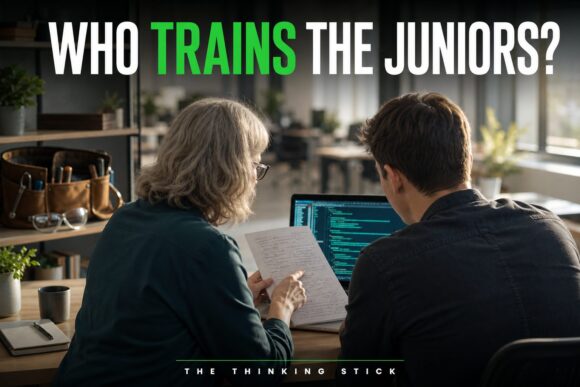
- Pair every new hire with a named person. Not a buddy for the first week. Someone whose job includes teaching them for the first year, with time set aside to do it.
- Make the next rung visible. The trades can say exactly what an apprentice has to show to move up. Can you? Write down what proof of readiness looks like for your entry-level roles.
- Rewrite one job posting. If an entry-level posting asks for skills only an experienced person has, either it isn’t an entry-level job or your training plan is missing.
Frequently asked questions
Is AI eliminating entry-level jobs?
Not across the whole economy, at least not yet. Stanford research reported by Fast Company found no widespread displacement, but employment for 22- to 25-year-olds in the most AI-exposed jobs is about 19% lower than expected, mostly because companies are hiring fewer of them. Economists also point to interest rates and a slow hiring market as major factors.
Why should employers invest in training junior employees if they might leave?
Because the pipeline of experienced people has to come from somewhere. If no one trains beginners now, there are fewer skilled mid-career people later. And with the pay premium for job-hopping shrinking, as Fortune reported this week, young employees have more reason to stay where they are growing.
What can office employers learn from apprenticeships in the trades?
Apprenticeships pair beginners with experienced workers, put them on real work early and make each step of progress clear. Knowledge-work employers can borrow that structure: named mentors, real tasks with feedback, and a visible definition of what someone has to show to move up.
The ladder doesn’t build itself
For a long time, organizations could count on the career ladder building itself. Juniors did the small work, learned along the way, and eventually weren’t junior anymore. AI is breaking that accident. That’s not all bad. It forces us to be intentional about something we were never very intentional about.
The trades never stopped training their beginners. Young people noticed. Maybe the rest of us should too.
If your organization is working through how to grow early-career talent while AI changes the work, this is what I do with leaders every week. You can find me at JeffUtecht.com.
So here’s my question for you: in your organization, where does a new hire learn judgment now that AI is doing the first draft?
Sources
- Job-hopping got workers an 18% raise in 2022. Now it’s 8%—and Gen Z is hurt the most — Fortune, Muskaan Arshad, October 7, 2026
- Young workers are turning toward AI-proof jobs — Fast Company, Peter Saalfield, October 7, 2026
- Touch grease: Gen Z ditches office work for hands-on careers — The San Francisco Standard, Jillian D’Onfro, October 10, 2026