Two stories from K-12 Dive came out this week, two days apart, and I haven’t stopped thinking about them together. One says chronic absenteeism is still far above where it was before the pandemic, and progress has slowed. The other says SAT scores went up for the class of 2026, across every demographic group.
Here’s the thing. If you only listened to the loudest story in education right now, you’d think the explanation for everything happening in our schools fits in a student’s pocket. These two stories say the picture is a lot bigger than that.
Last week, when I wrote about cell phone bans, I asked whether we were too sure the phone was the main story, and whether chronic absenteeism deserved more of our attention. This week we got fresh numbers. So let’s look at them.
Key takeaways
- Nationally, chronic absenteeism was 22.6% in 2025, down from 28.3% in 2022 but still well above the 15.4% rate in 2019, according to an AEI analysis reported by K-12 Dive.
- Progress is slowing overall, but states that committed to a shared goal, like Iowa and Rhode Island, are cutting absenteeism faster.
- SAT scores rose 16 points for the class of 2026, with gains across all demographic groups, though fewer students took the test.
- Before we blame screens for what we see in achievement, we should ask a simpler question first: are students in the room?
What the new chronic absenteeism data shows
On October 2, K-12 Dive’s Anna Merod reported on a new American Enterprise Institute analysis of chronic absenteeism across 45 states. A student is chronically absent when they miss 10% of the school year, roughly 18 days.
The numbers tell a story of a long climb back:
- 2019 (before the pandemic): 15.4%
- 2022: 28.3%
- 2024: 23.5%
- 2025: 22.6%
So yes, things are better than the peak. But the drop from 2024 to 2025 was less than a point. At that pace, we are years away from where we were in 2019.
There’s good news inside the data, too. Iowa cut its rate from 21.6% to 15.8% in one year, which AEI’s Nat Malkus called “one of the largest drops in absenteeism for one state.” Rhode Island is nearly back to pre-pandemic levels. Both states are part of the 50% Challenge, which sets a goal of cutting chronic absenteeism in half within five years. States in the challenge averaged a 5.7% reduction from 2023-24 to 2024-25, compared with 3.2% for states that weren’t. Iowa’s McKenzie Snow described what it took as a “holistic approach” with whole communities working together.
The same day, the Magnolia Tribune reported (via the Meridian Star) that Mississippi’s chronic absenteeism rate fell from 27.6% to 26.5% in the 2025-26 school year, after the state adopted new attendance policies. Grades 6-12 had the highest rates.
Two days earlier, K-12 Dive’s Kara Arundel reported that SAT scores rose for the class of 2026. The average score was 1,045, up 16 points from the class of 2025, with gains in both reading/writing and math across all demographic groups. About 42% of test-takers met the college and career readiness benchmarks in both sections.
To be fair, that SAT number comes with real caveats, and the article names them. About 1.95 million students took the test, a 2.5% drop and the first decline in participation since 2021. Ninety percent of U.S. colleges are still test-optional. And the test itself changed in 2024 to a shorter, digital format with much shorter reading passages, although College Board research found the format change didn’t meaningfully affect reading performance. One year of SAT data from a smaller group of test-takers is not a trend, and I’m not going to pretend it is.
Here’s what the screen-time headline leaves out
Let me state the other side fairly, because a lot of thoughtful parents and educators hold it. The argument goes something like this: smartphones arrived, social media took over, attention spans shrank, and achievement followed them down. Get the phones out, and learning comes back. I understand why that story is appealing. It’s simple, it’s visible, and every adult has watched a teenager scroll.
I’m not saying screens don’t matter. They do. How students use them matters a lot. I wrote about this back in 2010 in Active vs Inactive Screen Time, and I still believe the difference between creating and consuming is the conversation we should be having.
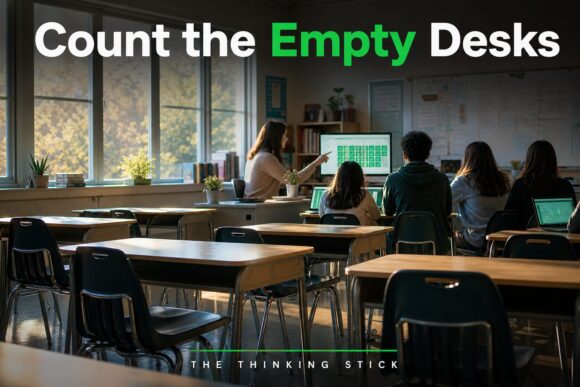
But here’s what bothers me. The phone gets the headline. The empty desk gets a footnote.
Think about what a 22.6% chronic absenteeism rate means in a real school. In a class of 25, that’s about five or six students who will miss at least 18 days this year. Not 18 minutes on a phone. Eighteen days of instruction, conversation, feedback and relationships with the adults in the building. No phone policy in the world teaches a student who isn’t there.
And the SAT story, with all its caveats, is a reminder that achievement can move in the same years when nearly every teenager has a phone. That doesn’t prove phones are harmless. It does suggest the “screens ruined a generation” story is too simple to explain what we’re seeing.
So I keep coming back to questions. Why are so many students still missing so much school? What role does the long tail of the pandemic play? What changed about how students and families see school, and what school is for? Why are grades 6-12 the hardest to get back in the building in a state like Mississippi? And why did states that set a shared goal and brought whole communities to the table move faster than states that didn’t?
None of those questions has a lock box for an answer.
We have a choice about where we put our energy
Every school leader I work with has a limited amount of time, money and political capital. When a community debate gets loud, that energy flows to whatever is most visible. Right now, that’s phones.
But look at what the data says actually moved the needle in Iowa and Rhode Island: a clear goal, shared across a state, with a whole community working on it. That’s not a device policy. That’s leadership. In Human Still Required, I argue that the work that matters most in schools, the judgment, the relationships, the trust, has to stay human. Getting a kid who has drifted away from school to walk back through the door is about as human as this work gets. A text reminder can help. A relationship with an adult who notices you’re gone is what brings you back.
This is also an equity question. Students who miss the most school are often the ones who already face the most barriers. I wrote about this in 2020 in Inequity Should Not Equal Inaction. The answer to a hard problem isn’t to grab the easiest lever. It’s to do the harder work.
Preparing students for their future, not our past, starts with having them in the room. Then it means making that room worth showing up for, which includes teaching them how to use the technology that will be part of every job they ever hold.
What schools can do this week
You don’t need a new policy to start. Here are a few moves any school or district can make right now:
- Put your attendance data next to your achievement data. Before your next conversation about test scores, look at which students missed 18 or more days last year. Ask what that tells you.
- Name one adult for every chronically absent student. Not a system. A person who checks in, notices and follows up.
- Ask students why. Hold a short listening session with students in grades 6-12 about what keeps people home. You may hear things your data can’t tell you.
- Look at what Iowa and Rhode Island did. Read up on the 50% Challenge and ask whether a shared, public goal could work in your district.
- Keep the phone conversation, but make it a teaching conversation. Teach students when to connect and when to disconnect, and talk about why, instead of treating a ban as the whole plan.
Frequently asked questions
What is chronic absenteeism?
A student is chronically absent when they miss 10% or more of the school year, roughly 18 days, for any reason. According to the AEI analysis reported by K-12 Dive, the national rate was 22.6% in 2025, compared with 15.4% in 2019.
Are phones the main reason test scores dropped?
The evidence doesn’t support a single cause. Screens can matter, especially how students use them, but other factors are in play, including pandemic disruption and attendance that is still well above pre-pandemic levels. And as the class of 2026 SAT results show, scores can rise in the same era when nearly every teen has a phone, though that one-year result comes with caveats.
What actually helps reduce chronic absenteeism?
In the latest data, states that joined the 50% Challenge, a shared goal to cut chronic absenteeism in half in five years, reduced it faster than other states. Iowa’s education department pointed to a holistic approach that brings whole communities together. Relationships with caring adults and listening to students are good places for any school to start.
The empty desk deserves the headline
I’ll keep pushing back on the idea that technology is the villain in every story about schools. Not because technology is perfect, but because the simple story keeps pulling our attention away from the harder, more human work that actually changes things for kids.
If your school or district is trying to sort out where to put its energy, attendance, AI, phones and all of it, this is the work I do with leaders every week. You can find me at JeffUtecht.com.
So I’ll ask you: in your school, does the phone get more airtime than the empty desk? And what would change if we flipped that?
Sources
- Progress to reduce chronic absenteeism slows nationwide — K-12 Dive, Anna Merod, October 2, 2026
- SAT scores are up across the board for class of 2026 — K-12 Dive, Kara Arundel, September 30, 2026
- Mississippi’s chronic absenteeism rate shows decline year over year — Magnolia Tribune via Meridian Star, Jeremy Pittari, October 2, 2026