For two years now the headlines about AI and entry-level jobs have mostly sounded like a countdown. The machines are coming for the first rung of the ladder, and Gen Z is going to be standing at the bottom looking up. So when a new working paper landed this week saying the spike hasn’t shown up yet, I read it twice.
Here’s the thing. The good news in that paper is real. But it is not a reason for schools to relax. If anything, it is a window. And the same week, North Carolina showed us what using that window can look like.
Key takeaways
- A new NBER working paper by UCLA economists Robert Fairlie and Jane Wu finds no statistically significant spike in unemployment for recent college graduates in summer 2026.
- The researchers are clear it may be too soon to draw firm conclusions, and other research using payroll data has found weaker trends for young workers in AI-exposed jobs.
- Schools should treat this moment as a window, not a reprieve: the bridge from school to work has to be built before the first rung changes, not after.
- Paid youth apprenticeships and well-designed work-based learning, like North Carolina’s summer academies, are the kind of bridge K-12 can build right now.
What the new research on AI and entry-level jobs actually says
The paper is “The Early Impacts of AI on Employment among Recent College Graduates”, released as an NBER working paper in September 2026 by Robert W. Fairlie and Jane Wu of UCLA. They used Census Bureau Current Population Survey data to look at bachelor’s degree holders ages 22 to 25 who were not enrolled in more school, across the summers of 2022 through 2026. Then they compared them with same-age workers without degrees and with older college graduates ages 30 to 49.
Their answer: unemployment for recent grads did not spike in summer 2026. As TechSpot reported in its coverage of the study, the rate was 7.3% this summer, higher than the 6.3% in 2022 but below the 7.8% recorded in 2024. Even when the researchers widened the measure to include people who said they wanted a job, they found no statistically significant increase.
That’s worth celebrating for a minute. The class of 2026 had access to ChatGPT before the end of their first semester of college, and they were not wiped out the summer they graduated.
But I want to be fair about what this study does and doesn’t say. The researchers themselves said it may be too soon to draw firm conclusions. The study measures unemployment, not how many entry-level jobs are being created or what those jobs now ask people to do. And it is not the only evidence out there. TechSpot points to a Stanford study that used ADP payroll records and found weaker employment trends for younger workers in AI-exposed occupations. As TechSpot put it, the finding “does not mean that AI has had no effect on the job market. It means the effect is not yet clear in this particular measure of employment.”
So the honest summary is: the research is mixed, and the people closest to it are telling us to keep watching.
Not yet is not never
Here’s what worries me about a headline like “not yet.” In schools, “not yet” has a way of turning into “not our problem.”
I hear some version of this question in almost every session I run with school leaders: should we change how we prepare students for careers because of AI, or is that just hype? I understand why they ask. Schools have been told the sky is falling about a lot of things. Waiting for the data is a reasonable instinct.
But think about who this study is about. These are 22-to-25-year-olds with bachelor’s degrees. The students sitting in our ninth-grade classrooms right now will hit that same job market around 2033 or 2034. Nobody can tell you with confidence what an entry-level job looks like then. What we do know is that the tasks we used to give new hires to learn on, the first drafts, the summaries, the basic analysis, are exactly the tasks AI tools are getting good at.
If the first rung of the ladder is going to look different, the bridge to it has to look different too. And bridges take years to build.
Preparing students for their future, not our past. That line has never felt more literal to me than it does right now.
What a real bridge looks like
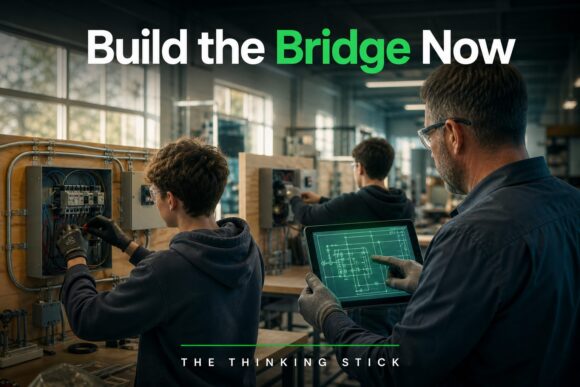
Which is why the announcement from North Carolina Governor Josh Stein on October 1 caught my eye. More than 500 high school students completed summer pre-apprenticeship and youth apprenticeship academies this year through the North Carolina Business Committee for Education (NCBCE), in electrical trades, advanced manufacturing, agriculture, biotechnology and health care.
A few details stood out to me. In the Careers Electric academies, 220 students combined community college coursework, industry-recognized credentials and work-based learning across 12 community colleges. NC Career Launch, NCBCE’s statewide youth apprenticeship initiative funded by a U.S. Department of Labor grant, has now supported 1,067 students who completed youth apprenticeships in 48 counties, with more than 165 employers, since 2024. And a BioWork pre-apprenticeship served 13 rising seniors and recent graduates on the autism spectrum through a 140-hour certificate in biotech and pharmaceutical manufacturing.
These apprenticeships give North Carolina’s high school students the chance to learn hands-on and earn a paycheck as they explore career pathways in high-demand industries.
Governor Josh Stein, October 1, 2026
Learn hands-on. Earn a paycheck. Explore. That’s three things a paper resume can’t give a student, and three things an AI tool can’t do for them.
Now, I’ll admit 500 students in a summer is not a whole state. The Governor’s own workforce council has set a goal of doubling apprenticeships statewide, which tells you they know it isn’t enough yet either. But it is a working model, with employers, community colleges and K-12 at the same table. That’s the part most places are missing.
Not every experience is a learning experience
There’s a catch, and Chris Unger names it well in a Getting Smart post published October 1. His opening line: “Not all experiences result in impactful and valuable learning.” A field trip to a factory is an experience. So is a career day. Neither is the same thing as doing real work.
Unger points to three things participants kept naming as what mattered most: the chance to dig into a topic that was personally relevant and of value, the chance to try, practice and fail in authentic activities of the field, and detailed, constructive feedback from someone qualified to give it. He also warns about equity, and I think this is the line every superintendent should read:
If access depends on a family’s connections, unpaid time, transportation, or an adult who happens to make an introduction, these opportunities can widen gaps as easily as close them.
Chris Unger, Getting Smart, October 1, 2026
Yes… that’s exactly the trap. If the only students who get real work experience are the ones whose parents can make a phone call, AI won’t be what widens the gap. We will.
I wrote back in 2013 in Millennials and the Job Market that a public portfolio of real work would matter more than a paper resume. I believe that even more now. When anyone can produce a polished cover letter in thirty seconds, what a graduate can show — work they did, for a real audience, with feedback from real professionals — is the signal that still means something.
In Human Still Required, I argue that AI didn’t break school — it exposed it. The school-to-work bridge is one of the places it exposed. We’ve been running career exposure for years and calling it career preparation. The tools changed. The job of getting kids ready for real work didn’t.
What schools can do this week
- Count the real stuff. How many of your juniors and seniors did paid or credit-bearing work-based learning last year, not a career fair or job shadow? Get the actual number, and break it down by student group.
- Call your community college. North Carolina’s model runs through community colleges. Ask what pre-apprenticeship, dual credit or credential programs could pair with a summer placement for your students.
- Ask three local employers one question: “What does your entry-level job look like now that your team uses AI, and what would you want a 17-year-old to be able to show you?” Bring the answers to your next leadership meeting.
- Start a portfolio, not a resume. Pick one course or advisory where every student publishes one piece of real work for a real audience this semester, with feedback from someone outside the school.
- Remove one barrier. Transportation, unpaid time, or a missing introduction. Pick the one that keeps the most students out and fix it first.
Frequently asked questions
Is AI taking entry-level jobs from young people?
Not clearly, at least not yet. A September 2026 NBER working paper by UCLA economists found no statistically significant spike in unemployment for recent college graduates in summer 2026. Other research using payroll data shows weaker trends for young workers in AI-exposed jobs, so the evidence is mixed and still early.
What is a youth apprenticeship?
A youth apprenticeship lets high school students learn a trade or profession on the job, usually paid, while earning credentials or college credit. North Carolina’s NC Career Launch has supported 1,067 students in youth apprenticeships with more than 165 employers since 2024.
What can K-12 schools do to prepare students for AI-shaped jobs?
Give students real work for real audiences: apprenticeships, internships, dual credit and portfolio projects with professional feedback. Partner with community colleges and local employers, and remove barriers like transportation and unpaid time so access doesn’t depend on family connections.
The window is open
The best reading of this week’s research isn’t “relax.” It’s “you have a little time.” Use it to build the bridge while the river is still crossable.
If your school or district is figuring out what career-connected learning should look like in an AI world, that’s the work I do with leaders every week. You can find me at JeffUtecht.com.
So here’s my question for you: how many of your students got to do real, paid or credit-bearing work before they graduated last year? And what would it take to double that number?
Sources
- The Early Impacts of AI on Employment among Recent College Graduates — Robert W. Fairlie and Jane Wu (UCLA), NBER Working Paper, September 2026 (covered by TechSpot, September 26, 2026)
- Governor Stein Highlights Summer Apprenticeship Academies Preparing More Than 500 High School Students — Office of North Carolina Governor Josh Stein, October 1, 2026
- Why the Experience of Experience Matters — Chris Unger, Getting Smart, October 1, 2026