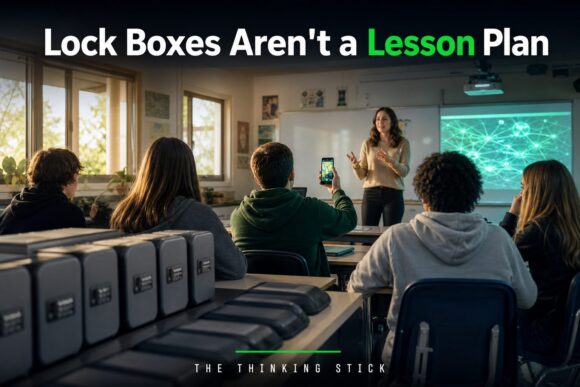
On October 1, Senators Mark Kelly and Tom Cotton introduced a bipartisan bill that would put federal money behind cell phone bans in schools. The day before, Education Week ran a story on a year-long survey showing that teen phone use in class climbed steadily from fall to spring, even in schools with bans on the books.
Read those two stories back to back and you get the whole debate in miniature. Washington is ready to buy lock boxes. The data says the lock boxes are the easy part.
Here’s the thing…. I’m not here to tell you phone bans are wrong. I’m here to say a ban is a policy, not a lesson. And if that’s all we do, we’ve missed the point.
Key takeaways
- A new bipartisan Senate bill would fund states that adopt school-day phone restrictions, paying for lockers, lock boxes and pouches.
- A USC survey reported by Education Week found the share of teens who used a phone in class rose from 28% to 42% over the 2025–26 school year.
- The largest study of bans so far found near-zero average effects on test scores, with well-being gains showing up only after a few years.
- Bans can buy focus during the school day; only teaching builds the habits students carry into the rest of their lives.
What’s happening with cell phone bans in schools
The bill is called the UNPLUGGED Schools Grant Act of 2026. According to Senator Kelly’s October 1 announcement, it would create a federal grant program for states that adopt policies keeping students from possessing or using personal devices during school hours. The money pays for storage: lockers, lock boxes, phone pouches. States would have to build their policies with districts, educators, parents and students, keep a way for parents to reach their kids through school staff, and include exceptions for students with health conditions, disabilities or special needs.
Senator Kelly didn’t mince words:
Phones in schools have been a disaster for learning.
Sen. Mark Kelly, October 1, 2026
Jonathan Haidt, quoted in the same release, went further, calling for every school in America to “go bell-to-bell phone free” and saying that phone-free schools “almost always report increased student engagement, decreased disciplinary problems.” Straight Arrow News reported that 42 states plus Washington, D.C., and Puerto Rico have already enacted cell phone-related school legislation, citing the National Conference of State Legislatures. So this isn’t a new idea. It’s a national stamp on something most states have already done.
Now the other story. Education Week’s Arianna Prothero reported on September 30 on a survey from researchers at the University of Southern California that followed teens across the 2025–26 school year. At the start of the year, 28% of teens said they had used a phone in class. By the end of the year, it was 42%. Forty-four percent said their teachers grew more lenient about enforcement over time.
The researchers did find good news. Bell-to-bell bans held up better: phone use in those schools went from 25% to 35%, compared with 32% to 50% in schools with looser rules. And teen attitudes softened over the year. USC researcher Dan Silver told Education Week there is “light at the end of the tunnel” for school leaders. He also said something every teacher will recognize:
It’s much easier to be really intentional about enforcing this policy when it’s new, when it’s the beginning of the year.
Dan Silver, USC, in Education Week
Then there’s the bigger research picture. The Straight Arrow News coverage of the bill points to the large national study (released as a National Bureau of Economic Research paper) that found bans cut phone use but showed “no major impact on student test scores, attendance or attention” at first, with improvements in student well-being showing up later. Stanford’s Thomas Dee put it plainly: building phone-free schools “does not appear to be a simple or quick fix.”
I’ll admit it: the ban side has a point
Let me be fair here. Teachers are tired of competing with a buzzing pocket. A Democrat and a Republican co-wrote this bill, which tells you how broad the support is. The well-being gains in the national study are real and worth taking seriously, and the USC data says bright-line rules are easier to enforce than “use your judgment” rules. If your school went bell-to-bell and your hallways feel better, I’m not going to argue with you.
But look at what the bill actually funds. Lockers. Lock boxes. Pouches. Storage.
There is nothing in a pouch that teaches a 14-year-old when to pick up a phone and when to put it down. There is nothing in a locker that helps a student notice how an app is designed to pull them back in. The test score results are close to zero on average. Enforcement fades by spring. So what are we actually buying?
A ban is a policy. Teaching is the lesson.
I wrote about this in 2019 in Whack-A-Mole Is Not A Classroom Management Strategy That Works. Blocking and banning turns teachers into enforcers. Students find the workaround, teachers chase it, and by spring everybody is tired. The USC numbers read a lot like that post. Nobody is failing here. It’s what happens when the main tool is control instead of learning.
And here’s the part the headlines skip: the hours that matter most are outside the school day. School is seven hours. The phone is there the other seventeen. A ban can protect the classroom, but it can’t build the habit a student needs at 10 p.m. on a school night. Only teaching does that.
Back in 2016 I wrote We have a choice, They don’t. Adults get to decide how much technology is in our lives. Our students don’t. Their future jobs, their relationships and their civic life will run through devices. That’s why I keep coming back to the same line: we should be preparing students for their future, not our past. A future-ready student is not one who has never held a phone during school. It’s one who knows when to connect, when to disconnect, and can tell you why.
I’d also ask: why are we so sure the phone is the main story? If a ban moves scores by close to zero on average, what does that tell us about where the problem really lives? What role did the pandemic play? Chronic absenteeism? Teacher turnover? How we trained teachers to use the devices we handed out? Those are questions worth asking out loud before we spend federal money on hardware.
This is exactly the kind of leadership moment I write about in Human Still Required. The tools change. The leadership job stays the same: judgment, relationships, trust. Different tools. Same leadership work. A pouch can hold a phone. It can’t hold a conversation with a student about why they reach for it.
What schools can do this week
If your school already has a ban, keep it if it’s working. Then add the teaching the policy can’t do on its own:
- Teach the why, not just the rule. Spend one advisory or homeroom on how notifications and feeds are designed. Students follow rules they understand longer than rules they resent.
- Plan for spring, not just fall. The USC data shows enforcement drifts. Put a mid-year reset on the calendar now, with staff and students, instead of hoping September energy lasts.
- Separate personal phones from learning devices. Make sure a phone policy doesn’t quietly turn into a technology policy. Students still need to research, create and publish on school devices.
- Bring parents into the 17 hours. Host a family night on habits at home, including adult habits. Kids learn from what we model, and we’re on screens too.
- Ask students to measure their own use. Have them track a week of screen time and reflect on active vs. inactive use. Data they collect themselves lands differently than a lecture.
Frequently asked questions
Do cell phone bans in schools improve test scores?
Not much, based on current evidence. The largest national study, covered by Straight Arrow News, found bans reduced phone use but had no major early impact on test scores, attendance or attention. Well-being improvements showed up later, which suggests bans take sustained effort to pay off.
Are school phone bans working a year in?
Partly. The USC survey reported by Education Week found in-class phone use among teens rose from 28% to 42% over the year, and 44% said teachers grew more lenient. Bell-to-bell bans held up better than looser policies.
What would the federal UNPLUGGED Schools Grant Act do?
It would give grants to states that adopt policies keeping personal devices out of students’ hands during school hours. The money pays for storage like lockers and pouches, and states must include exceptions for health needs and disabilities.
Should schools teach phone habits instead of banning phones?
It doesn’t have to be either/or. A ban can protect learning time, but students also need explicit teaching on when to connect, when to disconnect and why. That’s the part that follows them home and into adulthood.
The question I’d leave you with
The UNPLUGGED Act may well pass. Most states are already there. Fine. Then let’s be honest that we’ve solved the storage problem, not the learning problem. The learning problem is ours, and it doesn’t come in a pouch.
If your school or district is working through phone policy, AI or the bigger question of what students actually need to learn, this is the work I do with leaders every week. You can find me at JeffUtecht.com.
So I’ll ask: if your school has a ban, what are you teaching alongside it?
Sources
- Kelly, Cotton Introduce Bipartisan Bill to Get Phones Out of Schools — Office of Sen. Mark Kelly, October 1, 2026
- Are Teens Starting to Accept Cellphone Bans? A New Survey Has Answers — Education Week, Arianna Prothero, September 30, 2026
- Bipartisan bill would reward states for banning cellphones in schools — Straight Arrow News, Julia Marshall, October 1, 2026